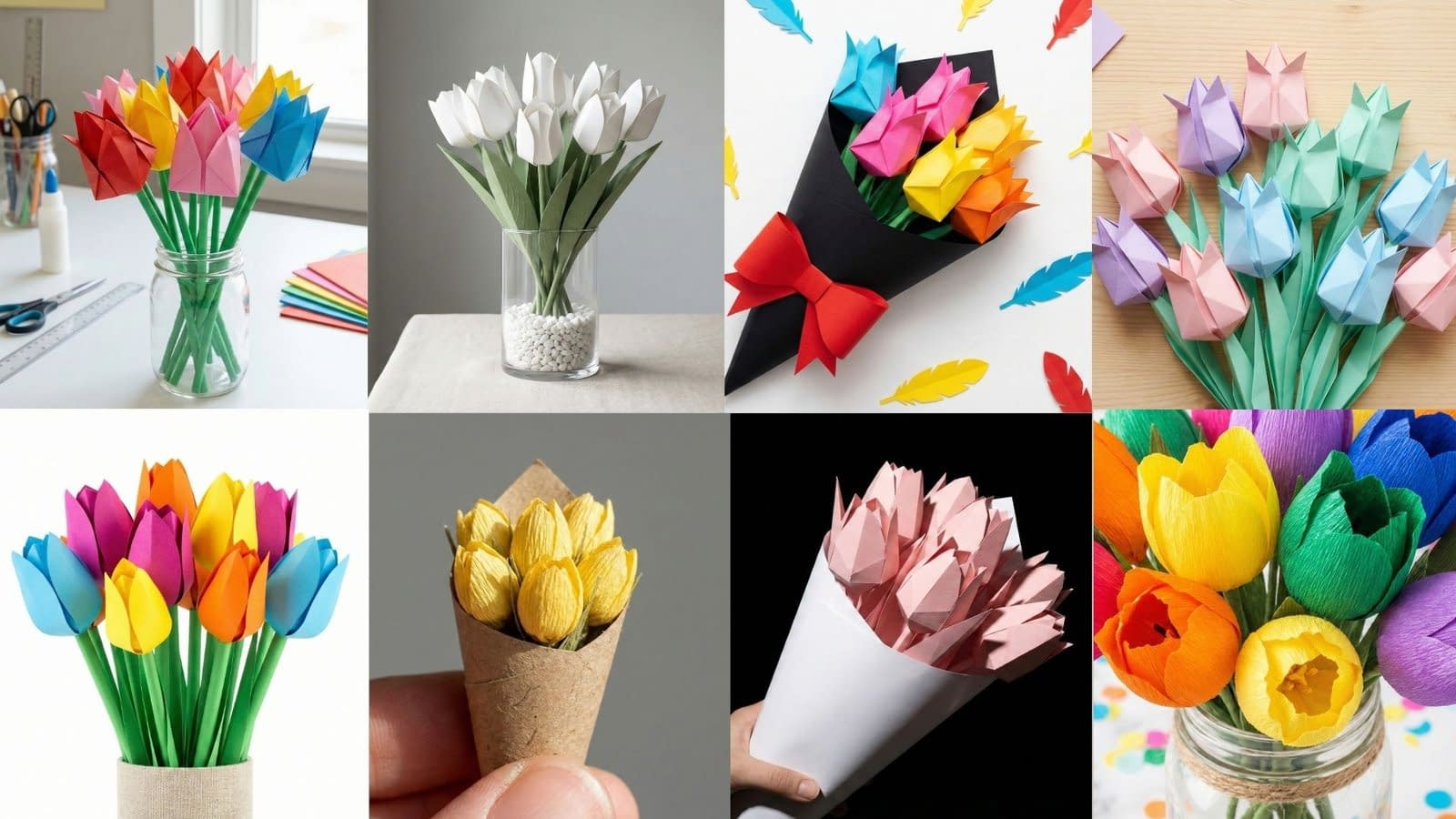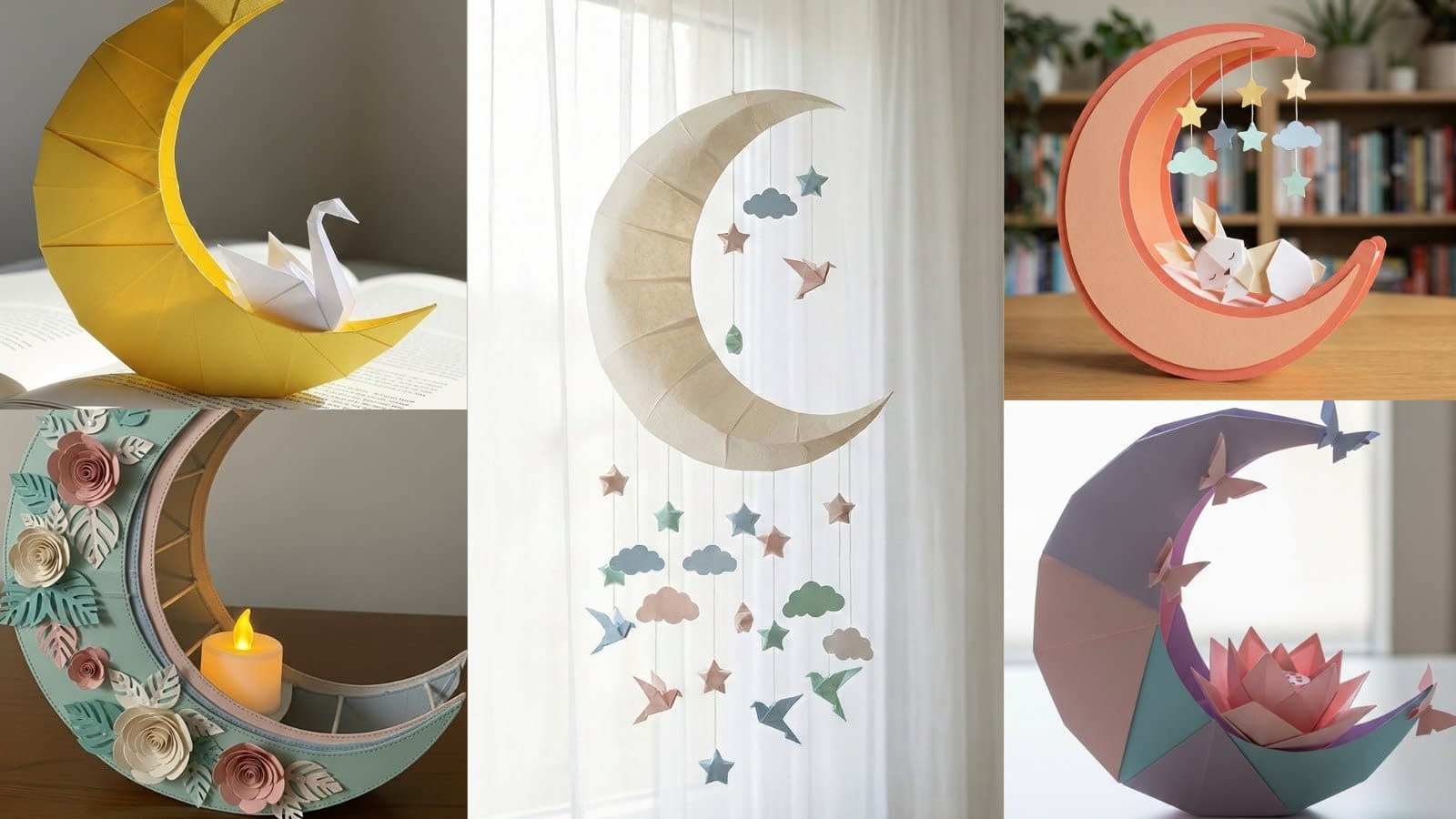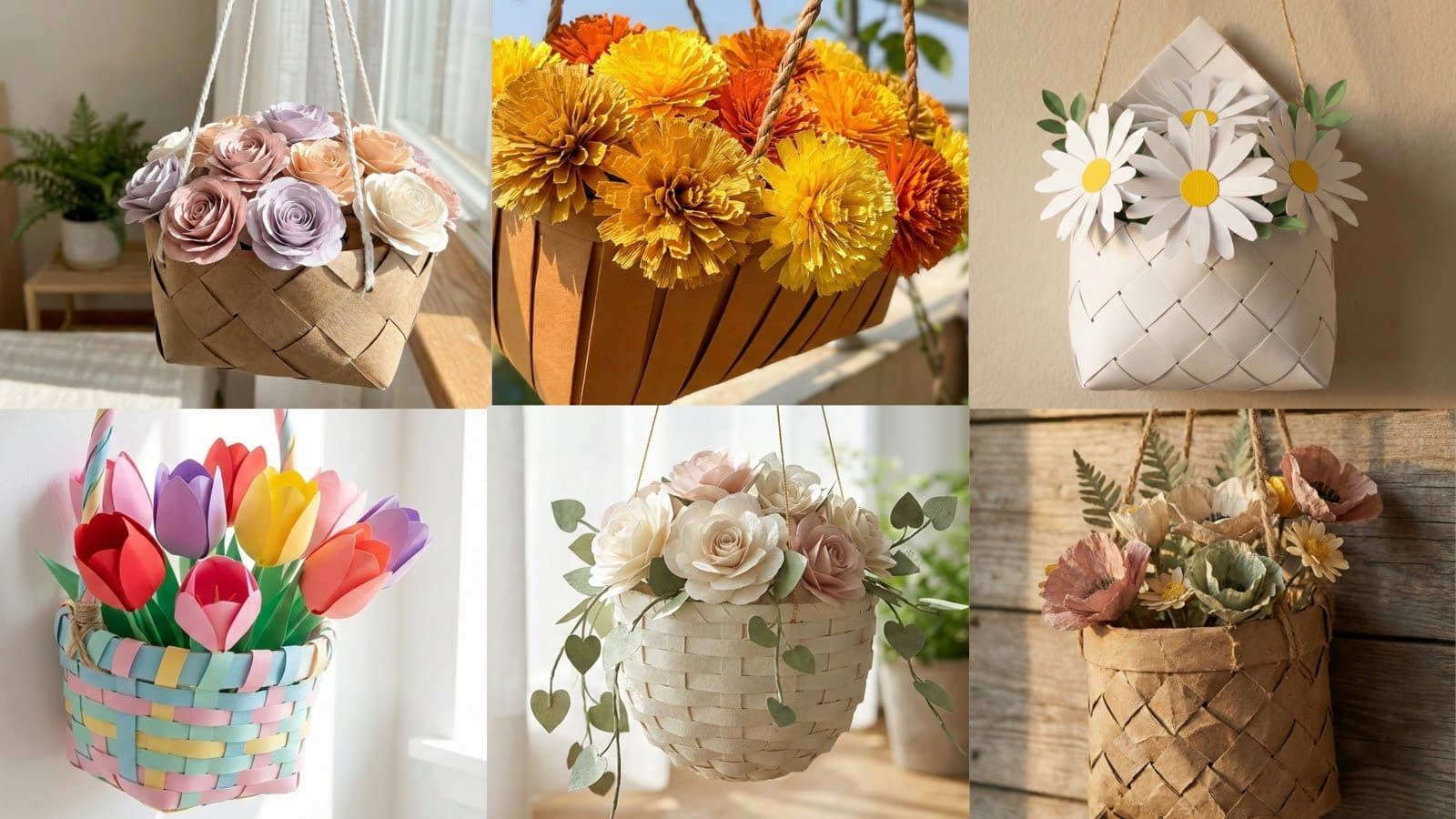
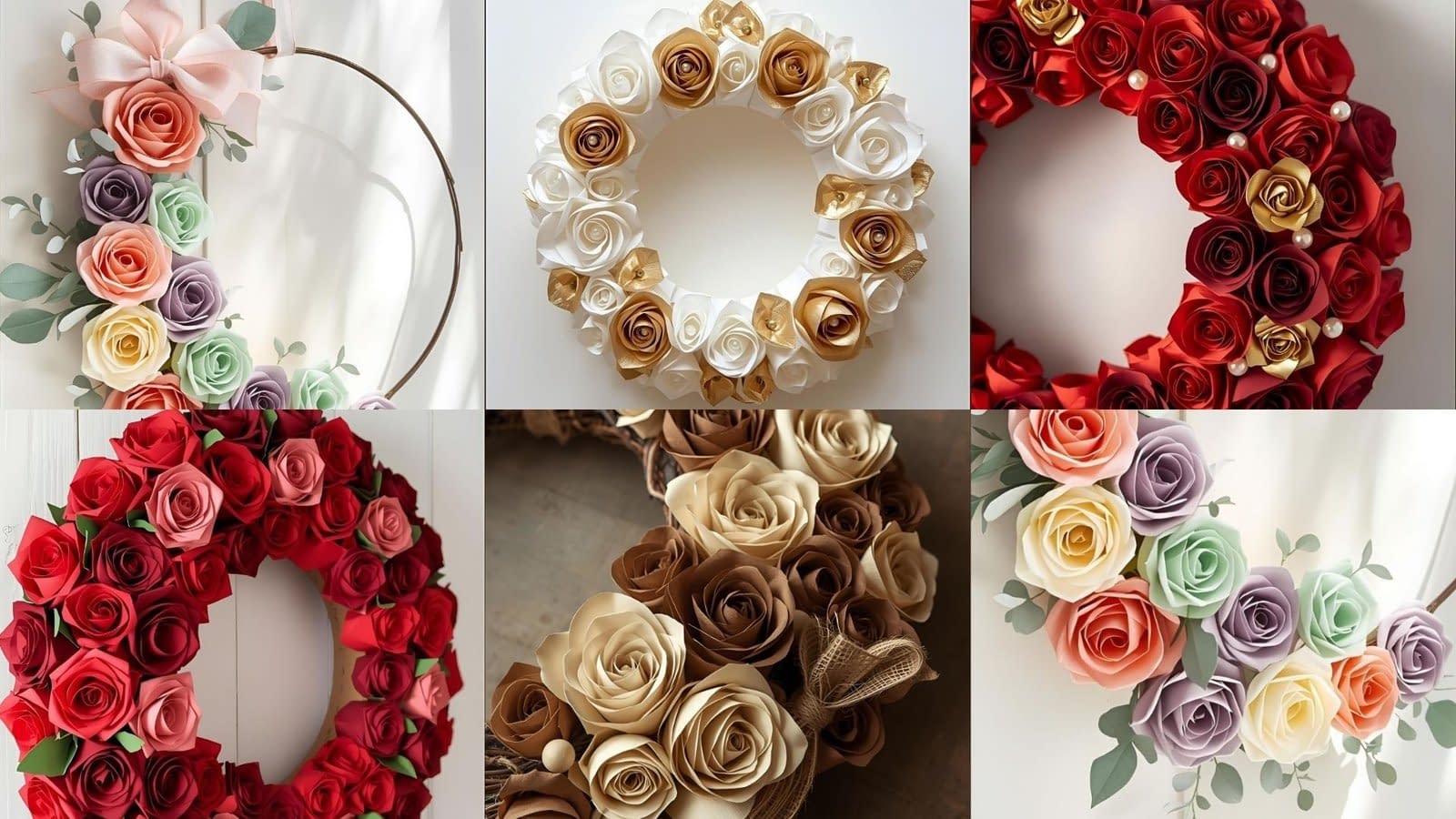
This post teaches you how to make five different rolled paper rose wreaths (Classic Red, Pastel Spring, Rustic Neutral, Christmas, and White & Gold). For each wreath I give exact measurements, how to cut spirals and petals, how to fold/roll and when to glue, how to build and arrange on the wreath base, finishing steps, and troubleshooting. You’ll also find general tips on paper choice, sizing, and storage.
Supplies, tools, and prep (common to all five wreaths)
Basic tools & consumables
- Cardstock (65–110 lb / 176–300 gsm) or patterned paper. Use heavier paper (100–110 lb) for roses that hold shape. Lighter cardstock (65–80 lb) is easier to roll for delicate petals.
- Scissors (sharp), or precision craft knife.
- Hot glue gun + glue sticks (low-temp for delicate papers; high-temp for fast hold on thicker cardstock).
- Craft cutting mat (if using a knife).
- Pencil, ruler, circle templates (or compass).
- Wreath base: options — cardboard ring (inexpensive), foam ring, grapevine wreath, or wooden hoop. For beginners, a 10–12 inch cardboard or foam ring is easiest.
- Optional: cutting machine (Cricut/Silhouette) and SVG files for spirals (speeds up cutting).
- Optional embellishments: faux leaves, ribbon, pearl pins, glitter paper, small pinecones or berries (for Christmas).
- Clear matte spray sealer (optional) for durability.
- Tweezers (helpful with small roses), toothpicks (for applying glue inside tight areas).
Workspace prep
- Work on a flat, clean surface with good light.
- Plug in hot glue gun and let warm up before you start rolling flowers (takes ~5 minutes).
- Lay out your color palette and group paper by size/weight.
Templates and sizes
You’ll make rolled roses from spiral templates. For consistent results use these circle diameters for spirals:
- Small rose: 2.5–3 in (6–7.5 cm)
- Medium rose: 3.5–4 in (9–10 cm)
- Large rose: 4.5–6 in (11.5–15 cm)
Cut square or circular paper slightly larger than the spiral diameter. For wreaths that are 10–12 in in diameter, plan to make:
- 24–32 medium roses, or
- 40–60 mixed small + medium roses, depending on fullness.
If you want SVGs for Cricut/Silhouette, tell me and I’ll generate templates sized for each rose.
How to cut a spiral (hand method) — foundation for all roses
- Draw a circle: use a compass or trace a bowl. Choose a diameter (see sizes above).
- Mark the center with a dot.
- Starting near the center, draw a spiral that widens evenly until it reaches the outer circle edge. The width of the spiral path determines petal thickness: about 3/8–1/2 in (9–12 mm) works well.
- Cut along the spiral from the outer edge toward the center (or vice versa — outer to center is easier to control).
- Leaving a small round disk at the center (about 1/2 in) is helpful — that becomes the rose base you’ll glue to. You can cut the very center out if you prefer a tiny hole.
Tip: If drawing spirals by hand is hard, use a cutting machine or print spiral templates and trace them.
How to roll and shape a rolled paper rose — the core technique
This step is the same across wreath styles; variations are noted later.
Step A — prepare the spiral
- If your spiral has even edges, you’ll get smooth petals. For more natural petals, lightly cut scallops or triangular notches along the outer edge before you roll.
Step B — start rolling
- Begin at the outermost edge of the spiral. Pinch the outer edge between thumb and index finger and start rolling toward the center. Keep the roll tight for the first 1/2–1 in (1–2 cm) — this becomes the center bud.
- Once the core is formed, let the roll loosen slightly as you continue so the petals open outward naturally. The degree you loosen determines how open the rose looks.
- When you reach the center disk, let the spiral sit so that the bottom of the rolled rose sits flat on the disk.
Step C — glue the base
- Apply a small bead of hot glue to the underside of the center disk and press firmly onto it. Hold 10–15 seconds until glue cools (or use a toothpick to press if the rose is small).
- If using low-temp glue, press and hold a little longer. If you cut the spiral so the last inner coil is tight, you’ll have a stronger center to glue to.
Step D — finishing touches
- Pinch the petal edges outward a little to create more dimensionality, or gently curl petal tips using a skewer or the edge of scissors (pull paper lightly across the scissor edge to curl).
Common problem: If your rose unrolls after gluing, more glue at the seam (where outer spiral meets central disk) will secure it. Apply a tiny dot; avoid adding so much glue that it shows.
How to flatten rose bottoms for gluing to a wreath base
- After gluing the center, press the bottom of the rose against a flat surface for 5–10 seconds while glue sets. This creates a small flat base and ensures the rose sits flush on the wreath ring.
- For foam bases, press gently into foam to create a small indent — this helps keep the rose stable.
Arranging roses on a wreath base — principles and layout strategies
Full wreath vs. half wreath
- Full wreath: cover entire ring with roses for a lush look.
- Half wreath (or cluster): concentrate roses on one side and leave the other side bare or add greenery — modern and less material-intensive.
Spacing
- Constant spacing: place roses edge to edge with centers about 1/2–1 in apart (dense).
- Clustered spacing: group a dense center cluster and add smaller roses moving outward.
Layering
- Start by gluing largest roses first in the main focal areas.
- Fill gaps with medium then small roses.
- Use leaves or filler between roses to reduce visible gaps and create depth.
Glue order
- Mark positions lightly on the wreath base so you have reference points (e.g., six main focal points).
- Glue focal roses first (usually 6–10 for a 12 in wreath).
- Fill in with remaining roses, working symmetrically to keep balance.
- Add filler leaves, ribbons, or accent pieces last.
Attachment techniques
- For cardboard bases: hot glue directly.
- For foam bases: apply hot glue, then press rose into foam; consider adding a dab of glue inside the foam hole for better hold.
- For grapevine rings: tuck rose base under vines and add a small amount of glue or wrap floral wire around the base and grapevine.
Wreath 1 — Classic Red Rolled Paper Rose Wreath (detailed tutorial)
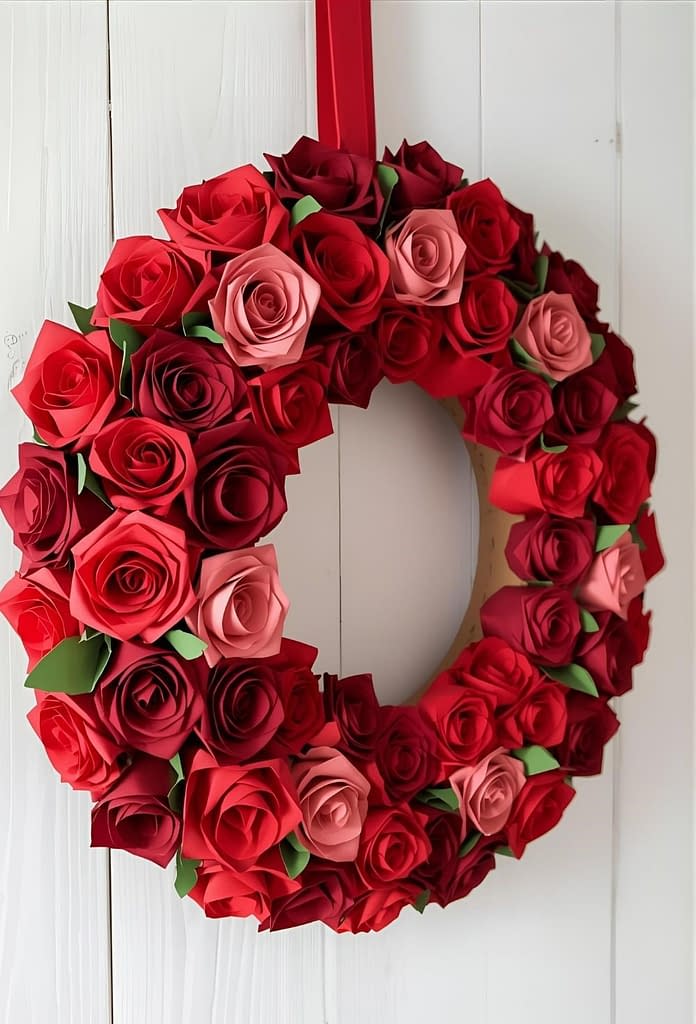
Goal: Classic, full 12 in wreath with red roses and two accent colours for depth.
Materials
- Red cardstock (100 lb) — 20 sheets (8.5 x 11 in) should be enough for 30–35 medium roses.
- Burgundy and blush cardstock for depth — a few sheets.
- 12 in cardboard wreath base (1.5–2 in wide ring).
- Hot glue gun, scissors, pencil, circle templates.
Cutting
- Cut circles 4 in diameter for medium roses (use cup or compass).
- On each circle draw a spiral as described.
- For variety, cut some 3 in circles for small roses and 5–6 in for a few large focal roses.
Rolling technique
- For the Classic Red look, roll centers tight, then gently open outer coils. Keep petals slightly cupped (curl outer edge outward with scissors or a dowel).
- Glue center disk under. Press bottom flat.
Assembly
- Mark ring positions at 12, 3, 6, and 9 o’clock for four focal roses.
- Glue focal roses to these positions using hot glue. Hold until set.
- Fill spaces between focal roses with medium roses, alternating red and burgundy for depth.
- Fill any small gaps with small blush roses.
- Add 4–5 paper leaves made from green cardstock tucked under clusters.
Finishing
- Add a small satin ribbon loop at the top for hanging.
- Optional: light dusting of metallic rub on petal edges for sheen.
Time estimates
- Cutting spirals: 45–60 minutes (faster with a cutting machine).
- Rolling roses: 60 minutes for 30 roses.
- Assembly & finishing: 45 minutes.
Total ~3 hours.
Wreath 2 — Pastel Spring Rolled Paper Rose Wreath (detailed tutorial)

Goal: Light, airy wreath of mixed pastel roses arranged loosely for a spring feel.
Materials
- Pastel cardstock: blush, mint, lavender, cream.
- 10–12 in foam wreath base (1 in thickness).
- Faux eucalyptus sprigs or paper leaves.
- Hot glue gun, scissors.
Cutting
- Use mixed diameters: 3 in (small) and 4 in (medium). For a light wreath, plan ~40 roses (more small than medium).
Rolling and shaping
- For pastel, roll slightly looser so petals look soft and open.
- For even more delicate petals, scallop the outer spiral edge before rolling.
Assembly
- For a loose spring look, do a half wreath (cover one side).
- Start with a row of medium roses centered on the bottom of the half section.
- Fill above them with alternating small roses, spacing centers about 3/4 in apart.
- Tuck faux eucalyptus sprigs and paper leaves into gaps. Glue stems behind roses and press into foam to hide glue lines.
Finishing
- Add a narrow pastel ribbon at the top left of the clustered half to soften the edge.
- Optionally, place a small paper butterfly or faux pearl in the center of a few roses.
Time estimates
- Cutting & rolling ~2–3 hours.
- Assembly ~30–45 minutes.
Wreath 3 — Rustic Neutral Rolled Paper Rose Wreath (detailed tutorial)

Goal: Soft, textured wreath using kraft paper, cream, and burlap accents for farmhouse style.
Materials
- Kraft paper and cream cardstock.
- 12 in grapevine or cardboard wreath.
- Burlap ribbon, jute twine, small wooden beads.
- Hot glue, scissors.
Cutting
- Use mainly medium (4 in) and a few large (5–6 in) roses for organic look.
- For kraft paper, consider sanding/lightly distressing edges for rustic effect.
Shaping
- Roll tightly for inner petals but leave outer coils a bit uneven for a handmade look.
- Slightly crumple kraft paper before rolling (gently) to add texture.
Assembly
- If using a grapevine wreath, weave the center disk under a few vine strands to anchor, then glue.
- Cluster roses asymmetrically (e.g., cluster of 10–12 on one side) leaving some vines visible for rustic charm.
- Wrap jute twine around the wreath base near the cluster and glue ends under a rose.
- Glue wooden beads sparsely for accent.
Finishing
- Tie a small burlap bow and glue at the cluster center.
- Optional: spray with matte sealer to prevent further crumpling.
Time estimates
- Cutting & rolling ~2 hours.
- Assembly ~30 minutes.
Wreath 4 — Romantic Red and Gold Rolled Paper Rose Wreath (Detailed Tutorial)

Goal:
Create an elegant, rich-looking red and gold rolled paper rose wreath perfect for everyday home décor, romantic occasions, or a timeless statement piece.
Materials
- Deep red and wine-colored cardstock for the main roses
- Metallic gold paper for accent roses
- 12-inch foam wreath base
- Small faux white berries or pearl accents (optional)
- Ribbon in gold or cream for hanging
- Hot glue gun and glue sticks
- Small floral picks or toothpicks for securing accents
Cutting
Cut a mix of small (2.5–3 inches) and medium (3.5–4 inches) rose spirals to create a full, dimensional wreath.
You’ll need about 35–45 roses for complete coverage of a 12-inch base.
Use gold metallic paper for about 6–8 accent roses so they catch the light and add visual interest without overpowering the red tones.
Shaping & Accent Technique
After cutting, roll each rose tightly at first, then loosen slightly to form soft layers.
Glue the base of each rose once the desired shape is achieved.
Attach faux white berries or pearl picks to short floral stems and secure them between some roses for a refined look.
If using gold roses, space them evenly around the wreath to create balance and flow.
Assembly
- Start by gluing the red roses closely together to cover the wreath base.
- Place darker red tones deeper in the design for depth, and keep brighter red roses toward the front.
- Add gold roses in a triangular layout (three main points) to draw the eye evenly around the wreath.
- Tuck your pearl or berry accents into small gaps and secure them with glue for a polished, layered appearance.
Finish by attaching a soft gold or cream ribbon at the top for hanging.
Alternatively, you can tie a small decorative bow at the bottom center for an elegant finishing touch.
Finishing
If you plan to hang the wreath outdoors, use weatherproof glue and apply a clear spray sealant to protect the paper.
For indoor display, a generous layer of glue along the base and rose edges will provide long-term hold.
Time Estimates
- Cutting & rolling: approximately 2.5 hours
- Assembly & detailing: approximately 45–60 minutes
Wreath 5 — Elegant White & Gold Rolled Paper Rose Wreath (detailed tutorial)

Goal: Sophisticated wreath for weddings or year-round elegance using white, cream, and touches of gold.
Materials
- White & cream cardstock, gold shimmer paper, embossing (optional).
- 12 in cardboard or wooden hoop base.
- Pearl pins, narrow satin ribbon, clear glue.
Cutting
- Use medium (4 in) roses primarily, with a few large focal roses.
- For gold accents, create very small roses (2–2.5 in) to sprinkle in.
Shaping
- Roll tight centers and very smooth outer coils. Use embossed/shimmer paper for a refined look.
- Optionally, glue a small pearl or bead in the center of a few roses.
Assembly
- Aim for symmetrical arrangement (full wreath) for formal look.
- Place four large focal roses at 90° intervals.
- Fill with medium roses and tuck small gold roses sparingly.
- Attach pearl pins by pushing them through the bottom disk and into the base (works well on foam or cardboard).
Finishing
- Add a narrow white satin loop for hanging.
- Lightly brush shimmer powder on edges for soft sparkle.
Time estimates
- Cutting & rolling ~2.5 hours.
- Assembly ~45 minutes.
Troubleshooting & professional tips
If petals look flat
- Re-roll and let outer coils loosen a touch. Curl the petal edges outward with a dowel or scissors to add dimension.
If roses unravel
- Add more glue under the center disk and along the inner seam. For heavy paper, use a thin bead of high-temp glue.
If wreath looks lopsided
- Step back and view from 6–8 feet away. Add a few small roses to the light side and tuck greenery to rebalance.
Color fading or curling over time
- Avoid direct sunlight; store in a box. Use clear matte spray sealer for long-term color protection.
Speed tips
- Use a cutting machine plus SVG spiral templates to cut dozens of spirals quickly.
- Work assembly-style: cut all spirals first, then roll all roses in one session, then assemble.
How many roses do I need?
- For a dense 12 in wreath: ~35–50 mixed roses.
- For a half-wreath: ~20–30 roses.
- For a sparse wreath: ~15–25 roses using more filler greenery.
Variations and finishing touches
- Mixed paper textures: Combine vellum, patterned, and metallic papers.
- Painted edges: Use watercolors or metallic rub to highlight petal edges.
- Layered wreaths: Glue roses onto a larger base and overlay with a smaller wreath for dramatic depth.
- Hanging clusters: Make matching mini wreaths (4–6 in) for gift tags or ornaments.
Storage and care (practical guide)
- Store flat in a shallow box lined with tissue paper.
- For long-term storage, keep humidity under 60% and away from direct sun.
- Dust with a soft brush or blow dryer on cool/low.
Closing notes — make it yours
These step-by-step tutorials are built so you can follow exactly how to cut, fold, roll, glue and arrange roses for each of the 5 Rolled Paper Rose Wreaths. You can scale the size, switch colors, or add seasonal accents