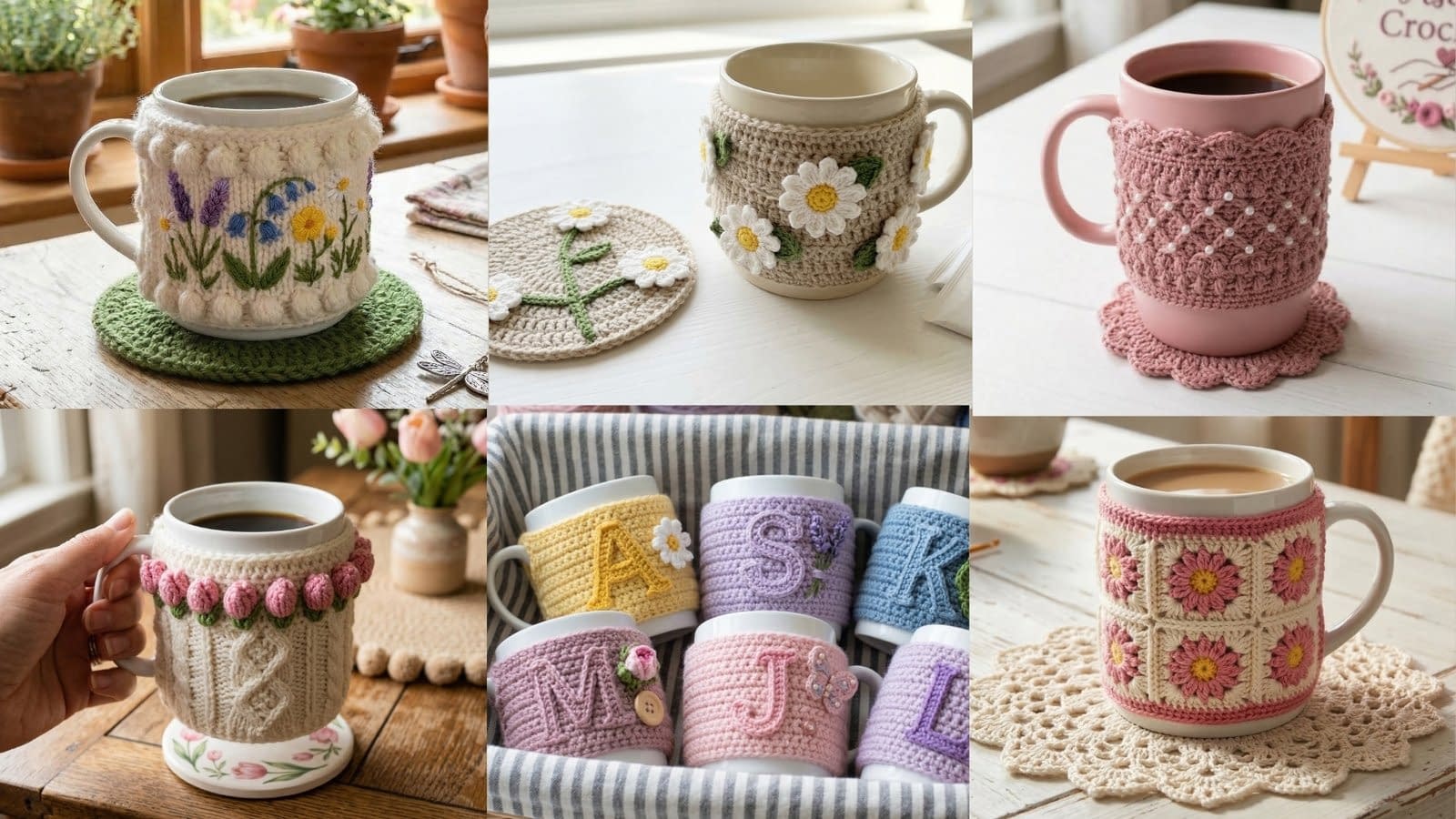
Hand-knit cup cozies are one of those small projects that deliver big satisfaction. They are quick to make, practical for everyday use, and endlessly customizable in texture, color, and style. In this guide to 7 Beautiful Knit Cup Cozy Patterns for a Soft and Cozy Look, the focus is on patterns that feel gentle, cozy, and visually pleasing while still being approachable for beginners.
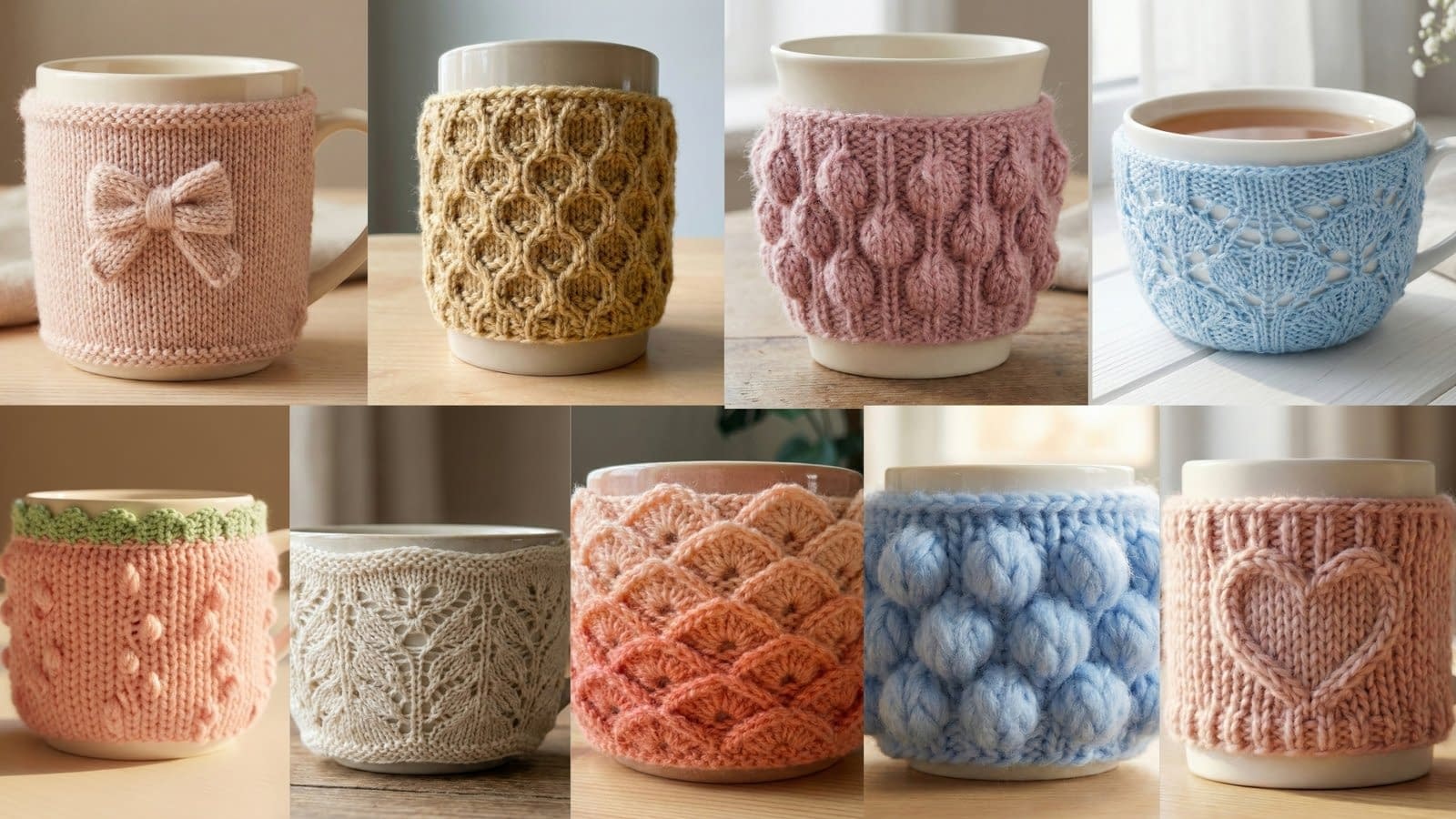
This post is written to help you truly understand how each cozy is constructed. Instead of rushing through instructions, each tutorial explains why certain stitches are used, how the fabric should behave in your hands, and how to shape the cozy so it fits a mug comfortably without slipping or stretching out. The visuals you provided show a range of textures, from smooth and delicate to deeply three-dimensional, and the tutorials below are carefully matched to those looks so readers do not get confused.
In this first part, you will find the first three knit cup cozy tutorials. Each one is written slowly and clearly, assuming you may be new to knitting textured projects. The remaining patterns can be added later when you ask to continue.
Getting started with knit cup cozies
Before jumping into the individual patterns, it helps to understand a few basics that apply to all knit cup cozies.
Cup cozies are usually knitted flat as a rectangle and then seamed, or knitted in the round as a tube. For beginners, flat knitting is often easier to control, especially when working textured stitches. Most of the patterns below are written as flat pieces that are later wrapped around the mug and sewn together.
You do not need scissors for cutting shapes or glue for assembly in knitting projects. All shaping and attachment is done using stitches, yarn tension, and simple sewing with a yarn needle. If you come from a paper or craft background, think of knitting as shaping fabric while you create it, rather than cutting and gluing later.
Always measure your mug before starting. A standard mug usually has a circumference of 9 to 10 inches and a height of about 3.5 inches. Your cozy should stretch slightly to fit snugly but not so tight that it distorts the stitches.
Heart Motif Knit Cup Cozy (Cute Pattern)
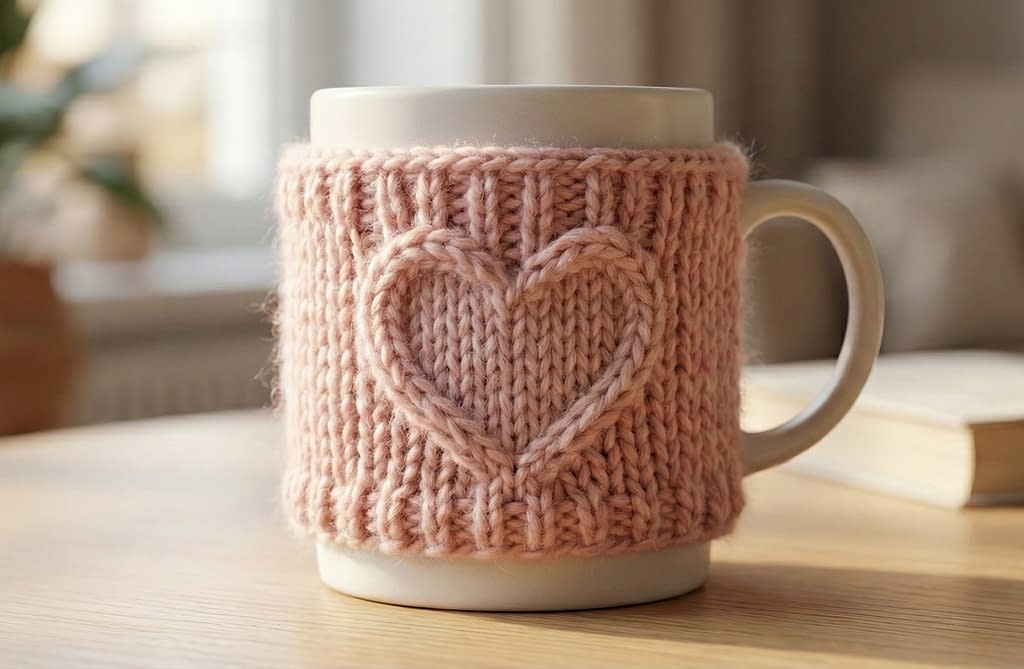
This pattern matches the soft blush pink cozy with a raised heart centered on the front. The heart is formed using knit texture, not embroidery, which gives it a subtle, handmade charm.
Materials and preparation
Choose a medium-weight yarn that feels soft but holds stitch definition well. Cotton-blend or smooth acrylic works nicely for this type of motif. You will need straight knitting needles appropriate for your yarn, usually size 4 to 5 mm, and a yarn needle for seaming.
Before casting on, wrap your yarn loosely around the mug to estimate width. The cozy should stretch gently when wrapped, so aim for slightly less width than the mug’s circumference.
Knitting the base fabric
Cast on enough stitches to create a rectangle that will wrap around the mug. For most standard mugs, this is around 36 to 40 stitches, depending on your yarn and tension.
Work several rows in a simple rib or garter stitch at the bottom edge. This creates a stable border that prevents curling. Knit slowly and evenly, making sure each stitch sits neatly on the needle.
Once the border is complete, switch to stockinette stitch for the main body. This smooth background allows the heart motif to stand out clearly.
Shaping the heart motif
The heart is formed by increasing and decreasing stitches in a small central section. As you knit the rows where the heart appears, pay attention to stitch placement. The raised effect comes from knitting certain stitches through the back loop or using small cables, depending on your preference.
As you work the heart, stop occasionally and lay the fabric flat on a table. This helps you visually check that the heart is forming symmetrically. Do not pull the yarn too tightly around the motif, as this can flatten the shape.
Finishing and assembling
Once the rectangle reaches the height of your mug, finish with a few rows of rib or garter stitch at the top edge. Bind off loosely so the cozy can slide onto the mug easily.
To assemble, wrap the cozy around the mug with the heart centered on the front. Use a yarn needle to sew the two short edges together using mattress stitch. This seam should be firm but flexible. Weave in all ends neatly along the inside so nothing scratches your hands.
Honeycomb Knit Cup Cozy (Geometric Texture)
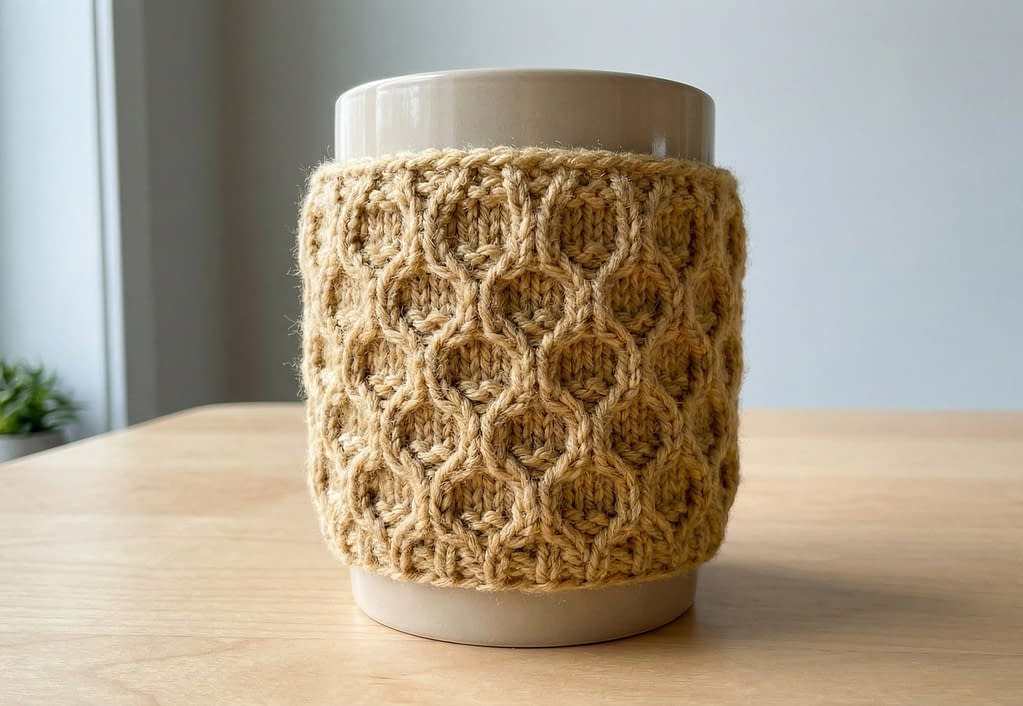
This pattern corresponds to the golden-beige cozy with repeating hexagonal textures. It has a modern look and feels structured yet cozy.
Understanding the honeycomb texture
The honeycomb effect is created by alternating knit and purl stitches in a repeating pattern. Unlike cables, this texture does not require crossing stitches, making it more beginner-friendly while still looking advanced.
Before starting the full cozy, it is helpful to knit a small swatch. This allows you to see how the honeycomb pattern emerges over several rows and helps you adjust tension.
Knitting the cozy body
Cast on a multiple of stitches required for the honeycomb pattern, plus a few extra for borders. Begin with a firm bottom edge, such as a twisted rib, to help the cozy grip the mug.
As you work the honeycomb rows, move slowly and count stitches often. The pattern relies on consistency. If you accidentally add or drop a stitch, the geometric shapes will look uneven.
Hold the fabric up to the light occasionally. You should see small recessed hexagon shapes forming naturally through the knit-purl structure.
Shaping and fit
This cozy should fit tightly around the mug to maintain crisp geometric lines. Avoid overly loose stitches. If the fabric feels too stretchy, consider using slightly smaller needles.
Once the desired height is reached, knit a few plain rows to create a clean top edge, then bind off.
Seaming and finishing
Wrap the cozy around the mug and align the honeycomb pattern so it flows continuously around the cup. Sew the edges together carefully, matching rows as closely as possible so the pattern looks uninterrupted.
Weave in ends discreetly, following the path of the stitches. This keeps the inside neat and comfortable to hold.
Tulip Bloom Knit Cup Cozy (3D Petal Texture)
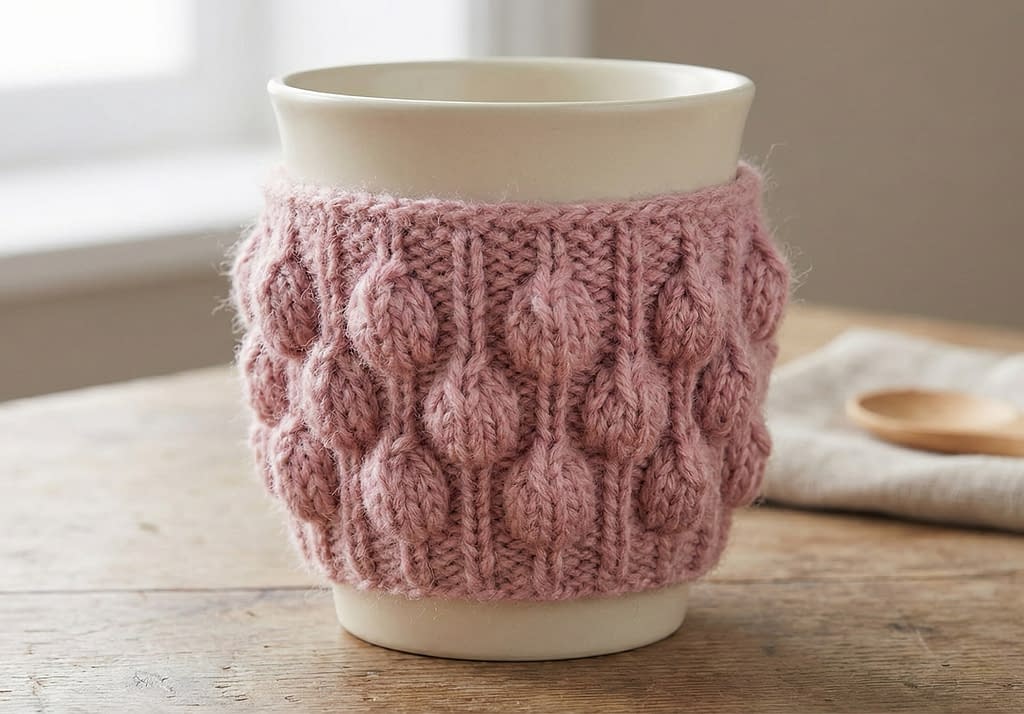
This pattern matches the dusty pink cozy with vertical rows of small raised petal-like bumps. It is soft, romantic, and perfect for showcasing three-dimensional stitch work.
Preparing for textured stitches
This cozy uses repeated puff or bobble-style stitches formed directly on the needles. These stitches require a bit more yarn and patience, but they are not difficult once you understand the rhythm.
Choose a yarn with some elasticity so the petals pop outward naturally. Avoid very slippery yarns, as they can make the texture harder to control.
Knitting the tulip texture
Cast on stitches for the cozy width and begin with a simple border. The tulip texture is worked in vertical columns, so it is important to keep your stitch count accurate from the start.
As you create each raised petal, pause to gently adjust it with your fingers. This helps the stitch sit properly and prevents it from being squashed by surrounding stitches.
Do not rush these rows. The beauty of this cozy comes from evenly spaced, well-formed petals that stand out clearly from the background.
Maintaining even tension
Because textured stitches use extra yarn, it is easy to accidentally tighten surrounding stitches. Focus on keeping your hands relaxed. After each textured row, gently stretch the fabric horizontally to even out tension.
Lay the piece flat frequently to check that the petals align vertically and do not drift sideways.
Final shaping and assembly
Once the cozy reaches the correct height, finish with a neat top border. Bind off loosely.
Wrap the cozy around the mug, adjusting the placement so the vertical petal columns look balanced. Sew the edges together with care, making sure the seam does not crush the raised texture.
Weave in all ends securely, hiding them behind the textured stitches where possible.
Cloud Puff Knit Cup Cozy (Soft Bubble Stitch)
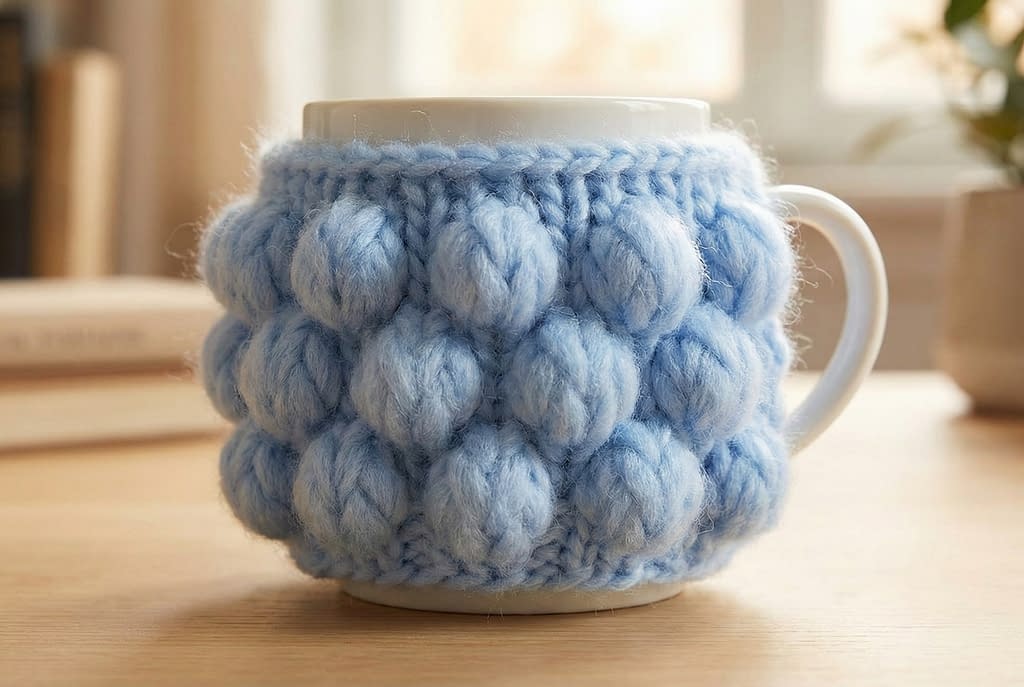
This tutorial matches the pastel blue cozy with oversized, cushiony puff stitches that look like soft clouds wrapped around the mug. The goal of this pattern is volume and softness rather than sharp definition, so your focus should be on relaxed tension and evenly spaced texture.
Materials and setup
Choose a fluffy yarn with visible loft. A lightly brushed acrylic, alpaca blend, or soft wool works best here. Avoid stiff cotton, as it will not create the pillowy effect shown in the visual. Use knitting needles one size larger than normally recommended for the yarn to enhance softness and stitch volume.
Before casting on, gently stretch the yarn between your fingers. You want it to feel airy, not tight. This mindset will help throughout the project.
Knitting the base structure
Cast on enough stitches to wrap around the mug with a slight stretch. This will usually be fewer stitches than a flat-pattern cozy because puff stitches add width.
Work the bottom edge in garter stitch for several rows. This gives a flexible base that prevents rolling and allows the cozy to slide on easily.
Switch to a simple stockinette or reverse stockinette background for the puff stitches. The smooth background helps the bubbles stand out clearly.
Creating the puff stitches
Puff stitches are made by working multiple yarn overs and knit stitches into the same stitch, then closing them together on a later row. When forming a puff, keep the loops loose on your needle. Do not pull them tight.
After completing a puff, gently tug the fabric below it downward and nudge the puff outward with your fingers. This physical shaping is important. Think of it as sculpting soft fabric rather than just knitting stitches.
Space the puff stitches evenly across the row, following the visual reference. Consistent spacing is what creates the calm, cloud-like rhythm of this design.
Managing tension and shape
After every few rows, lay the cozy flat and gently stretch it side to side. If the fabric looks stiff or flat, loosen your grip slightly on the next rows.
As the piece grows, lightly wrap it around the mug to check fit. The cozy should hug the mug without compressing the puff stitches.
Finishing and assembly
Once the cozy reaches the mug’s height, knit a few rows of garter stitch for the top edge. Bind off very loosely.
Wrap the cozy around the mug, making sure the puff stitches are evenly distributed across the front. Sew the short edges together using mattress stitch, being careful not to pull the seam too tight. A tight seam will flatten the bubbles.
Weave in ends by threading the yarn through the backs of puff stitches. This hides the yarn and preserves the plush look.
Cottage Lace Knit Cup Cozy (Delicate Openwork)
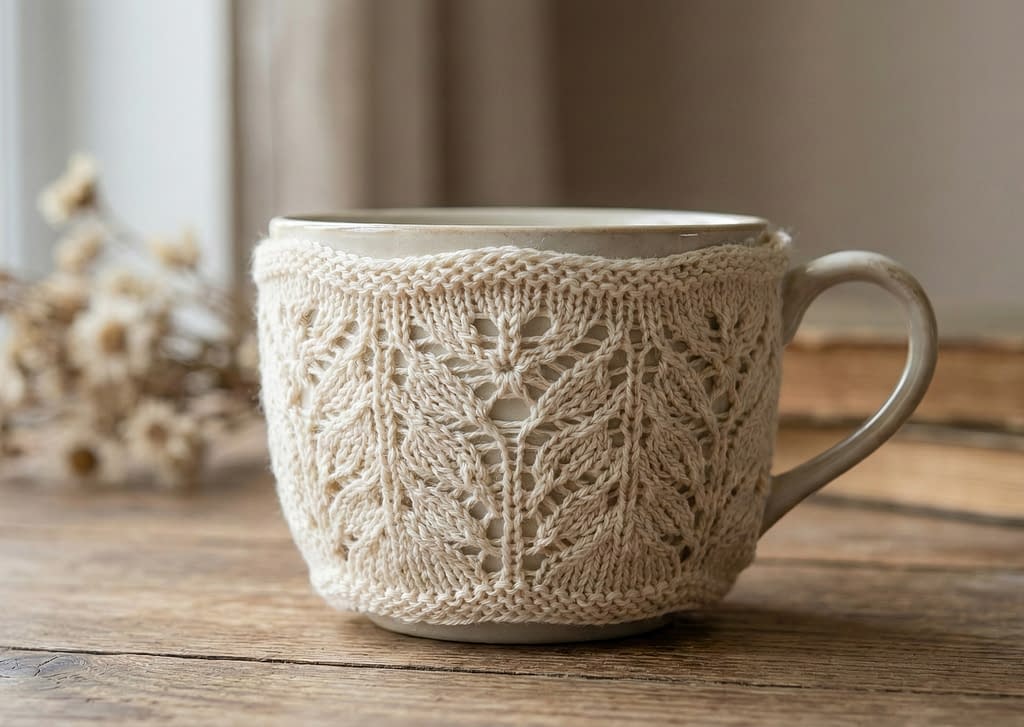
This tutorial corresponds to the cream-colored lace cozy with floral and leaf-like openwork. It has a light, vintage feel and works best on teacup-style mugs.
Yarn choice and preparation
Select a smooth cotton or cotton-blend yarn. Stitch clarity is more important here than fluff. Use needles that create a balanced fabric, not too tight and not too loose.
Before starting the full cozy, knit a small lace swatch. This helps you understand how yarn overs and decreases interact to form the pattern.
Knitting the lace pattern
Cast on stitches based on the lace repeat. Begin with a tidy bottom border, such as a narrow rib or garter stitch, to anchor the lace.
As you work the lace rows, read each row carefully before knitting it. Lace patterns rely on intentional holes created by yarn overs, so resist the urge to “fix” them.
After completing each lace section, gently stretch the fabric horizontally and vertically. This opens the lace and reveals the floral shapes.
Keeping the pattern aligned
Lace can drift if stitch counts are off. Count stitches at the end of every row. If you notice an error early, fix it immediately. Waiting too long will distort the pattern and make the cozy look uneven.
Use stitch markers between repeats if needed. They help maintain symmetry, especially for beginners.
Shaping for a snug fit
Because lace stretches more than dense fabric, knit the cozy slightly narrower than the mug circumference. The fabric should expand gently when wrapped around the cup.
Finish with a simple top border that mirrors the bottom edge. Bind off loosely to maintain elasticity.
Seaming and finishing touches
Wrap the cozy around the mug, aligning the lace motif so it looks centered and intentional. Sew the edges together carefully, matching lace rows so the pattern flows smoothly.
Weave in ends along the edges of lace motifs rather than across open holes. This keeps the design clean and elegant.
Scalloped Edge Knit Cup Cozy (Shell Texture)
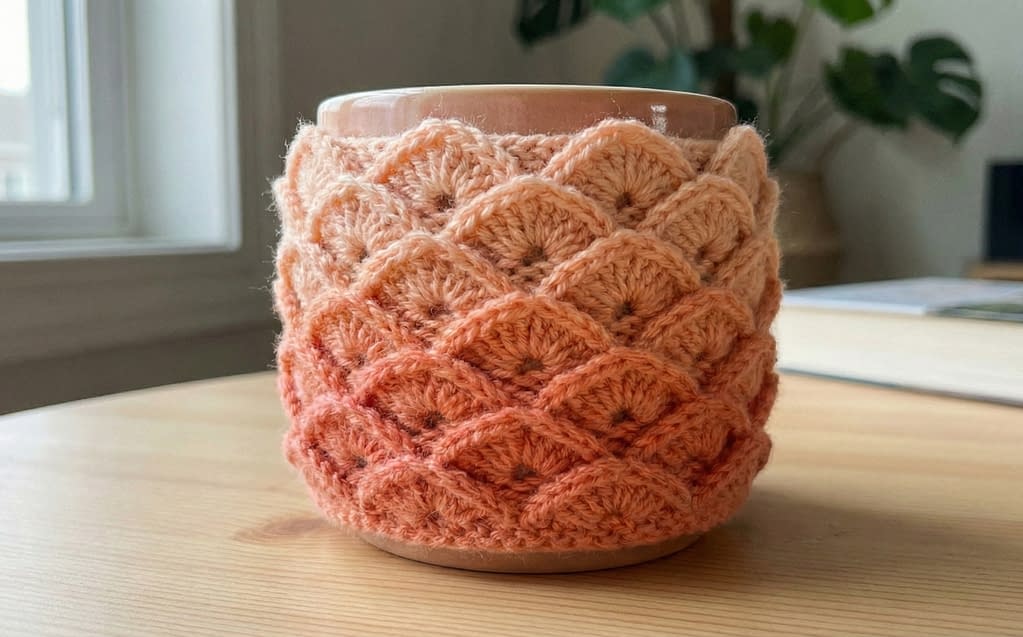
This tutorial matches the peach-to-coral gradient cozy with flowing, layered scallop stitches. The beauty of this pattern lies in movement and curved lines.
Choosing yarn and needles
A gradient or subtly shifting yarn works best to highlight the scalloped texture. Choose a yarn with good stitch definition but some drape.
Needles should be matched to the yarn weight, but if you want softer curves, go up half a size.
Knitting the scalloped texture
Cast on stitches that suit the scallop repeat. Start with a firm base edge to support the decorative rows above.
Scallops are formed by grouping stitches together and then spreading them across multiple rows. Knit slowly and watch how the curved shapes emerge.
After completing each scallop row, gently fan the fabric with your fingers. This encourages the curved edges to relax into place.
Maintaining flow and symmetry
Consistency is key. Each scallop should be the same width and height. If one looks smaller or tighter, check your tension and adjust on the next repeat.
Lay the cozy flat often and look at it from a distance. This helps you see whether the scallops are flowing evenly across the fabric.
Top edge shaping
Unlike simple cozies, this pattern benefits from a clean, understated top edge. Knit a few plain rows after the last scallop to frame the design without competing with it.
Bind off loosely but evenly.
Assembly and final shaping
Wrap the cozy around the mug and adjust placement so the scallops look balanced across the front. Sew the edges together carefully, keeping the seam straight so it does not interrupt the flowing pattern.
Weave in ends along the curves of the scallops. This hides the yarn and reinforces the shape.
Strawberry Cream Knit Cup Cozy (Pastel & Sweet)
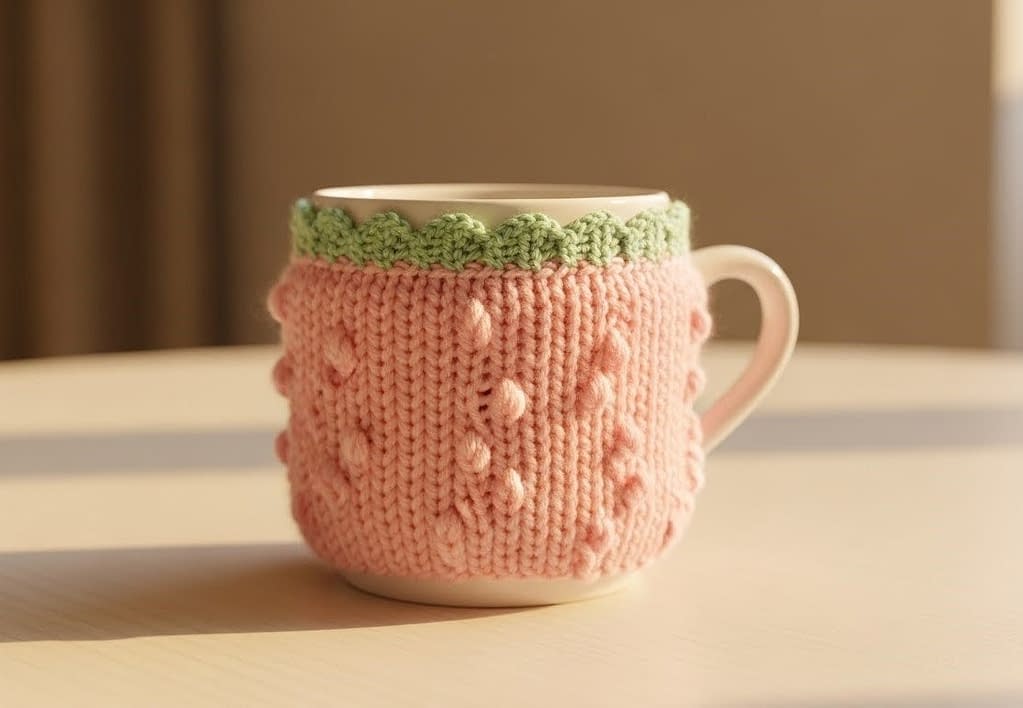
This tutorial matches the soft strawberry-pink cozy with tiny raised dots and a gentle green scalloped edge at the top. The overall look is sweet, playful, and calm, inspired by dessert-like colors and subtle texture rather than bold patterns.
Choosing yarn colors and texture
For the main body, select a pastel strawberry cream pink yarn with a smooth finish so the tiny raised dots remain visible and neat. Avoid very fuzzy yarns, as they can blur the small details. For the top edge, choose a soft pastel green yarn that complements the pink without overpowering it.
Use needles that give you even stitches. This pattern relies on consistency more than stretch.
Knitting the base fabric
Cast on enough stitches to wrap comfortably around the mug with a light stretch. Begin with several rows of garter stitch to create a stable bottom edge.
Move into stockinette stitch for the body. This flat surface is important because it allows the small raised dots to stand out clearly.
As you knit, occasionally wrap the piece around the mug to check width. The cozy should feel snug but not tight.
Creating the strawberry seed texture
The raised dots are formed using small bobble-style stitches worked at regular intervals. When making each dot, keep the loops slightly loose so the bump sits on top of the fabric rather than sinking into it.
After completing a row with raised dots, gently push each dot forward with your fingers. This physical adjustment helps maintain the “strawberry seed” look.
Space the dots evenly across the surface. Irregular spacing can make the pattern look messy instead of cute.
Knitting the green scalloped edge
Once the body reaches the correct height, switch to the green yarn. Knit a transition row evenly to avoid color gaps.
The scalloped edge is created by increasing and decreasing stitches in a repeating rhythm. Knit slowly and watch how the small curves form along the top edge.
Do not pull tightly on this section. A relaxed tension allows the scallops to sit softly against the mug rim.
Assembly and finishing
Wrap the cozy around the mug, aligning the raised dots so they appear evenly distributed. Sew the edges together neatly, keeping the seam straight.
Weave in ends along the inside of the fabric, following the stockinette stitches so the inside remains smooth and comfortable to hold.
Cloud Lace Knit Cup Cozy (Airy & Dreamy)
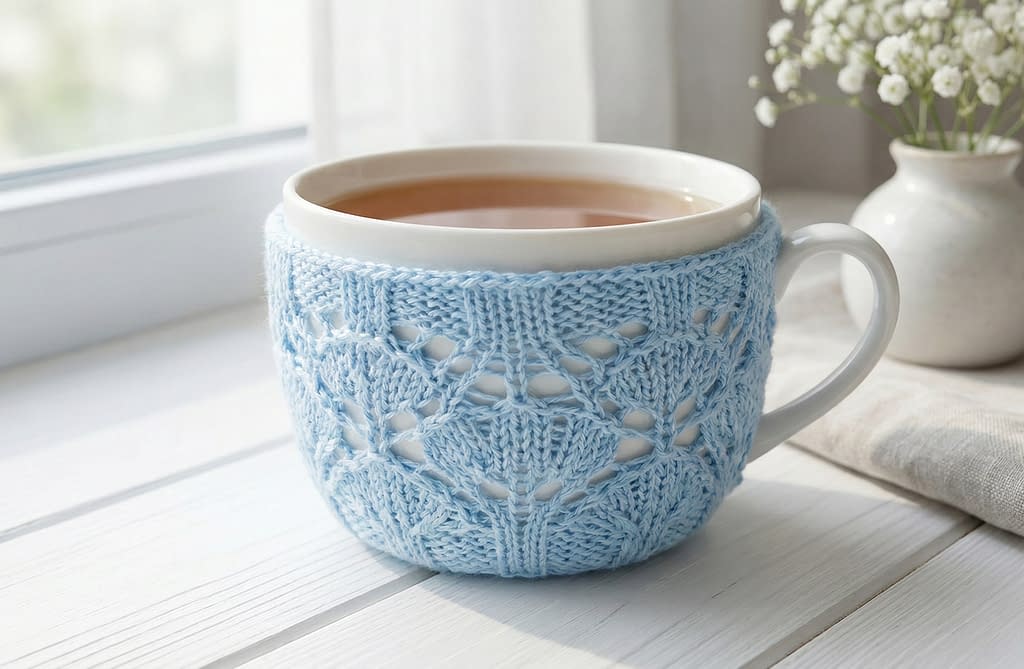
This tutorial matches the light sky-blue lace cozy with cloud-like openwork. It feels light in the hands and is perfect for delicate mugs or teacups.
Understanding airy lace structure
This pattern combines yarn overs and gentle decreases to create soft open spaces. The goal is not sharp holes but a floating, cloud-inspired texture.
Choose a smooth cotton yarn that holds shape without stiffness. Light-colored yarns work best for showing off lace detail.
Knitting the lace body
Cast on stitches based on the lace repeat. Start with a narrow garter stitch border to anchor the fabric.
As you knit the lace rows, read each row carefully before starting. Pay attention to yarn overs, as they are intentional and essential to the design.
After completing each lace section, gently stretch the fabric in both directions. This opens the lace and reveals the cloud-like shapes.
Maintaining balance and symmetry
Count stitches at the end of every row. Lace patterns depend on precise stitch counts to remain symmetrical.
If a section looks tighter than the rest, relax your tension slightly on the next repeat rather than pulling on the fabric afterward.
Top and bottom edges
Finish the top edge with a simple, clean border to frame the lace. Avoid heavy ribbing, which can overpower the delicate texture.
Bind off loosely to keep the cozy flexible.
Seaming and shaping
Wrap the cozy around the mug and align the lace motifs so they appear centered and intentional. Sew the edges together gently, matching rows as closely as possible.
Weave in ends along the solid parts of the lace, avoiding open spaces so the fabric remains clean and airy.
Bow-Knot Knit Cup Cozy (Delicate & Girly)
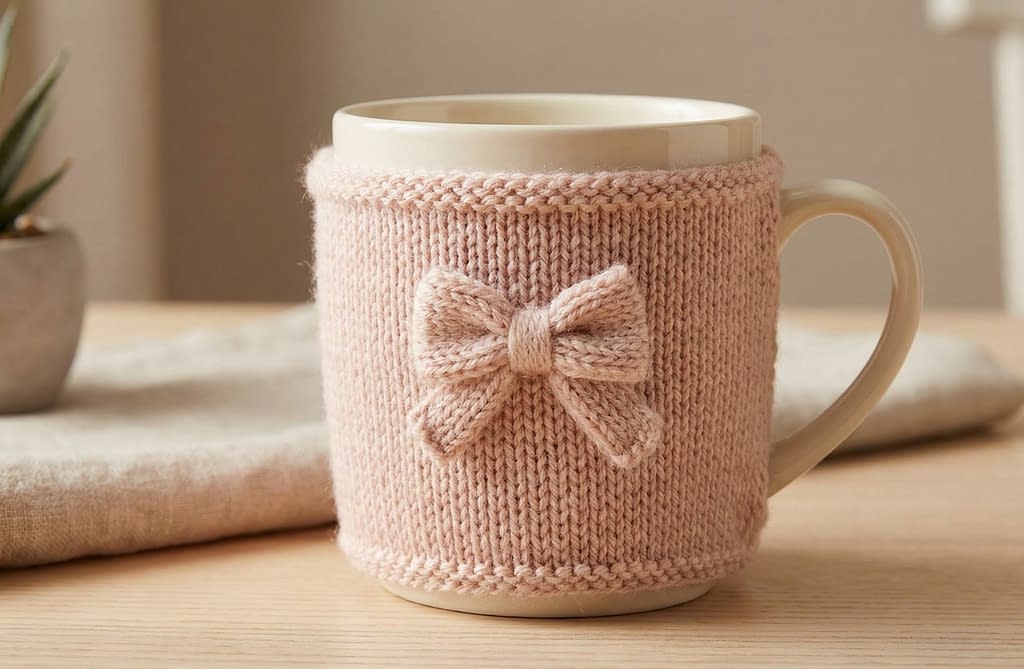
This tutorial corresponds to the blush pink cozy with a small knitted bow centered on the front. The design is simple but charming, making it ideal for gifts.
Knitting the main cozy body
Choose a smooth, soft yarn in a gentle blush shade. Stitch clarity is important here, as the bow should blend seamlessly with the base fabric.
Cast on stitches for a snug fit. Begin with a garter stitch border at the bottom, then work the body in stockinette stitch.
Keep your tension even throughout. Uneven stitches will be noticeable on such a clean design.
Creating the knitted bow
The bow is knitted separately as a small rectangle. Cast on a small number of stitches and knit a short strip in stockinette or garter stitch.
Once finished, bind off and gently fold the rectangle in half lengthwise. Wrap a short piece of yarn tightly around the center to create the bow shape.
Secure the wrap firmly, then leave long yarn tails for attaching.
Attaching the bow
Position the bow at the center front of the cozy while it is wrapped around the mug. This ensures correct placement.
Use the yarn tails to stitch the bow securely to the fabric. Sew through the back of the bow and into the cozy fabric several times so it does not shift during use.
Final edging and assembly
Finish the top edge of the cozy with a simple border that matches the bottom.
Wrap the cozy around the mug and sew the edges together neatly. Weave in all ends carefully, especially behind the bow, so no loose yarn shows.
Conclusion
These nine knit cup cozy patterns showcase just how versatile and expressive small knitting projects can be. From the gentle charm of heart motifs and bows to the bold structure of honeycomb textures and the softness of cloud-like puff stitches, each design offers a unique experience for both the maker and the user.
For beginners, these patterns provide a gradual learning path. Simple stockinette-based designs introduce shaping and seaming, while textured patterns teach control, patience, and stitch awareness. Lace and scalloped designs encourage knitters to slow down and observe how fabric forms through deliberate stitch choices.