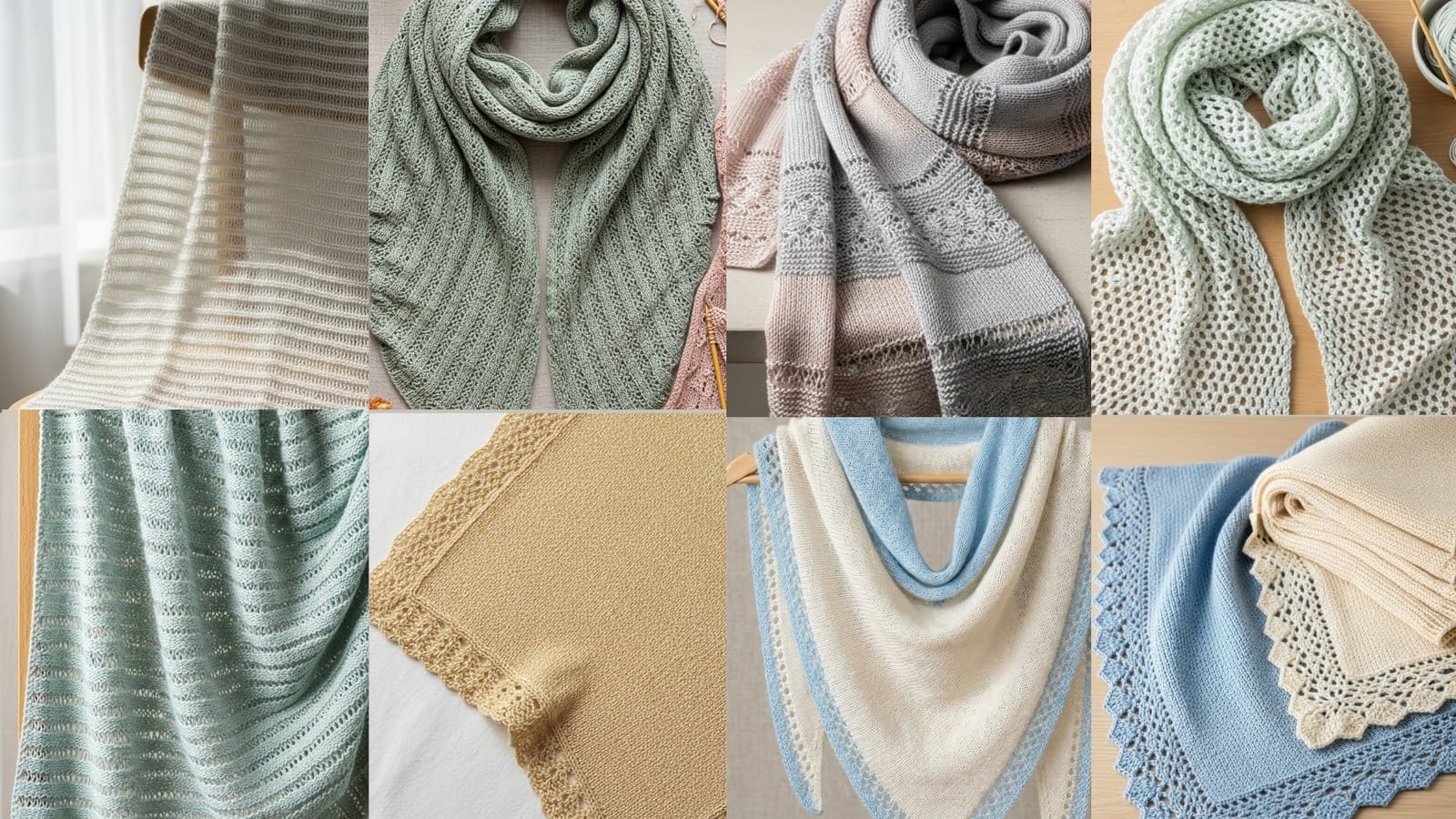
Lightweight knit summer shawls are ideal projects for knitters who want elegant results without heavy fabrics or complicated construction. Unlike winter shawls, summer shawls must balance beauty with breathability. This means choosing fine yarns, simple stitch structures, and shaping methods that create airflow and soft drape rather than thickness.
For beginners, shawls are especially valuable learning projects. They teach you how to manage increasing stitches, read your fabric as it grows, maintain even tension over a large surface, and finish a project neatly through blocking. However, many shawl patterns assume prior experience and use abbreviated instructions that can feel confusing or overwhelming.
Each pattern is explained slowly, clearly, and thoroughly, using full language rather than shorthand. Every section tells you what you are doing, why you are doing it, and what the fabric should look like before you move on. Even if this is your first shawl, you will be able to follow along confidently.
1. Featherlight Garter Stitch Summer Shawl

Skill Level
Beginner. This pattern is suitable even if you have only recently learned how to knit. You will use only the knit stitch, yarn overs, and basic counting. No complex stitch patterns or charts are required.
Finished Size
Approximately 60 inches wide along the top edge and 24 inches deep at the center point.
You can make the shawl larger or smaller by continuing or stopping earlier. Because this shawl grows gradually, size control is very flexible.
Materials
- Fingering-weight cotton or cotton-linen blend yarn, approximately 900 to 1,100 yards
Choose a smooth, light-colored yarn for your first attempt so you can clearly see the stitches. - Circular knitting needle, 4.0 millimeters (US size 6), at least 32 inches long
Even though the shawl is worked back and forth, circular needles are necessary to hold the growing number of stitches. - Two stitch markers
- Yarn needle
- Scissors
- Blocking mats and rust-proof pins
Why Garter Stitch Works for Summer Shawls
Garter stitch is created by knitting every stitch on every row. This produces horizontal ridges that make the fabric flexible, breathable, and naturally flat. For summer shawls, garter stitch allows air to move through the fabric and prevents curling at the edges, which means less frustration during finishing.
When worked with fine yarn, garter stitch becomes soft and slightly translucent, perfect for warm-weather layering.
Pattern Construction Overview
This shawl is worked from the top center outward, forming a shallow triangle.
- You will begin with only three stitches.
- On every row, you will add two stitches using yarn overs.
- One yarn over is placed near the beginning of the row.
- One yarn over is placed near the end of the row.
- All stitches are knitted on every row.
This steady increase creates clean, straight edges and a smooth triangular shape.
Understanding Yarn Overs Before You Begin
A yarn over is simply wrapping the yarn over the needle to create a new stitch. In this pattern, yarn overs are used as increases. Because garter stitch naturally hides holes, the yarn overs will blend smoothly into the fabric rather than forming decorative eyelets.
When making a yarn over:
- Bring the yarn forward between the needles.
- Then take it over the right-hand needle.
- Continue knitting the next stitch as normal.
Do not pull the yarn tight. The yarn over should be relaxed so the fabric stays flexible.
Step-by-Step Instructions
Cast On
Cast on three stitches using a long-tail cast-on method. This method creates a neat and flexible edge that works well for shawls.
Once cast on, place:
- One stitch marker after the first stitch
- One stitch marker before the last stitch
These markers show you where the edge stitches are. They help prevent missed increases, which is a common beginner mistake.
You should now have:
- One stitch
- Marker
- One stitch
- Marker
- One stitch
Row 1 (Right Side)
Knit every stitch across the row.
At the end of the row, you will still have three stitches.
Turn your work.
Row 2
Knit the first stitch.
Move the yarn forward and make a yarn over.
Knit every stitch until you reach the final stitch.
Before knitting the last stitch, make another yarn over.
Knit the final stitch.
You now have five stitches on your needle.
Turn your work.
Row 3
Knit every stitch across the row.
You are always knitting every stitch, including the yarn overs from the previous row.
Turn your work.
Row 4 and All Following Rows
Every row from now on follows the same structure:
- Knit the first stitch
- Make one yarn over
- Knit every stitch until one stitch remains
- Make one yarn over
- Knit the final stitch
Each row adds two stitches.
This means:
- After 10 rows, the shawl will still look very small.
- After 30 rows, the triangle will become visible.
- After 80 to 100 rows, the shawl will begin to drape across your needles.
This slow growth is normal.
Checking Your Work as You Go
Every few rows, stop and check:
- Your stitch count has increased by two stitches per row
- The edges look straight and even
- The garter ridges are consistent and not pulled tight
If one edge starts to curve inward, it usually means a yarn over was missed. If this happens early, it is best to gently undo a few rows and correct it.
When to Stop Knitting
Measure the shawl along the top edge, not the center point.
Once the top edge reaches approximately 60 inches, you can stop increasing and prepare to bind off. If you want a deeper shawl, continue knitting more rows.
Binding Off
Bind off all stitches loosely using a standard knit bind-off.
A loose bind-off is important. If the bind-off edge is too tight, the shawl will not block correctly and may feel stiff.
If you tend to bind off tightly, use a needle one size larger just for the bind-off row.
Finishing and Blocking
Weave in all loose ends by following the direction of the garter ridges. This hides the yarn tails and keeps the fabric smooth.
Soak the shawl in lukewarm water with a gentle fabric wash for at least 20 minutes.
Lay the shawl flat on blocking mats. Gently pull the corners outward to define the triangular shape. Smooth the edges with your hands rather than stretching aggressively.
Allow the shawl to dry completely before unpinning.
Blocking transforms garter stitch and gives this shawl its signature airy elegance.
2. Lace Panel Lightweight Knit Shawl

Skill Level
Advanced beginner to intermediate beginner. You should be comfortable knitting every stitch and making yarn overs. Decreases are explained in full detail and used sparingly.
Finished Size
Approximately 64 inches wide along the top edge and 26 inches deep at the center point.
The size can be adjusted easily by knitting more or fewer rows.
Materials
- Fingering-weight bamboo, cotton, or cotton-blend yarn, approximately 1,000 yards
Bamboo and cotton yarns highlight lace stitches clearly and remain cool against the skin. - Circular knitting needle, 4.0 millimeters (US size 6), at least 32 inches long
- Four stitch markers
- Yarn needle
- Scissors
- Blocking mats and rust-proof pins
Why Lace Panels Work Well for Summer Shawls
Lace panels create intentional open spaces in the fabric by combining yarn overs with matching decreases. This allows air to move freely through the shawl, making it comfortable in warm weather while adding visual elegance.
In this pattern, lace is used in vertical panels, which means:
- The shawl looks longer and more fluid when worn
- The lace does not overwhelm the design
- Beginners can focus on repeating one small lace sequence
The edges remain simple so the lace stays the focal point.
Construction Overview
This shawl is worked from the top center outward, just like Pattern 1.
Key differences:
- A single center stitch runs down the middle
- Lace panels sit on either side of the center
- Garter stitch borders frame the lace and prevent curling
You will increase stitches on every right-side row to form the triangular shape.
Understanding the Lace Stitches Used
Before starting, it is important to understand the two lace actions used:
Yarn over
This creates a new stitch and a small hole in the fabric.
Knit two stitches together
Insert the right needle into two stitches at the same time and knit them as one stitch. This decreases the stitch count by one.
In lace, yarn overs and decreases are paired so the total number of stitches stays balanced while holes are formed.
Cast On and Setup
Cast on five stitches using a long-tail cast-on.
Place stitch markers as follows:
- Knit one stitch, place a marker (left edge marker)
- Knit one stitch
- Place a marker (left lace marker)
- Knit one stitch (this is the center stitch)
- Place a marker (right lace marker)
- Knit one stitch
- Place a marker (right edge marker)
- Knit one stitch
These markers separate:
- The edges
- The lace panels
- The center stitch
Foundation Rows
For the first six rows:
- Knit every stitch across every row
These garter stitch rows stabilize the top edge and make the shawl easier to handle once lace begins.
Beginning the Lace Panels
From this point forward, rows alternate between:
- Right-side rows where lace and increases occur
- Wrong-side rows where all stitches are knitted
Right-Side Lace Row (Explained Slowly)
- Knit the first stitch.
- Make a yarn over. This is the left edge increase.
- Knit until you reach the left lace marker.
- Slip the marker.
- Make a yarn over.
- Knit two stitches together.
- Knit the center stitch.
- Knit two stitches together.
- Make a yarn over.
- Slip the next marker.
- Knit until one stitch remains.
- Make a yarn over.
- Knit the final stitch.
This sequence creates:
- Increases at both edges
- A balanced lace panel on each side of the center stitch
Wrong-Side Row
Knit every stitch across the row.
This keeps the borders flat and the lace easy to read.
Repeating the Pattern
Repeat the right-side lace row and the wrong-side knit row until the shawl reaches your desired width.
As the shawl grows:
- The lace panels will move farther apart
- The garter stitch borders will widen naturally
Checking Your Lace
Every few rows:
- Count stitches between markers
- Ensure yarn overs and knit-two-together stitches are paired
- Check that the lace panels mirror each other
If a mistake happens, fixing it early saves frustration.
Binding Off and Blocking
Bind off loosely using a knit bind-off.
Block the shawl firmly, stretching the lace panels gently to open the eyelets. Lace does not look complete until it is blocked.
3. Mesh Knit Summer Shawl

Skill Level
Advanced beginner.
Finished Size
Approximately 58 inches wide and 22 inches deep.
Materials
- Fingering-weight cotton yarn, approximately 900 yards
- Circular knitting needle, 4.5 millimeters (US size 7)
- Two stitch markers
- Yarn needle
Why Mesh Stitch Is Ideal for Hot Weather
Mesh stitch creates large, evenly spaced openings throughout the fabric. This makes the shawl extremely breathable and lightweight.
This pattern is ideal if you want:
- Maximum airflow
- Very fast visual progress
- A modern, minimal look
Construction Overview
The shawl is worked as a triangle from the top center outward.
Mesh is created by repeating:
- Yarn over
- Knit two stitches together
These actions cancel each other out, maintaining stitch count while creating openness.
Cast On and Setup
Cast on three stitches.
Place one marker after the first stitch and one marker before the last stitch.
Establishing the Shape
Row 1
Knit all stitches.
Row 2
Knit the first stitch.
Make a yarn over.
Knit to the last stitch.
Make a yarn over.
Knit the final stitch.
You now have five stitches.
Beginning the Mesh Pattern
From this point forward:
Right-Side Rows
- Knit the first stitch.
- Make a yarn over.
- Knit two stitches together.
- Repeat steps 2 and 3 across the row until one stitch remains.
- Make a yarn over.
- Knit the final stitch.
This creates the mesh openings.
Wrong-Side Rows
Knit every stitch loosely.
Loose tension is important. Tight knitting will reduce airflow.
Reading the Fabric
After several rows:
- You should see diamond-shaped openings
- The fabric should feel flexible and soft
- The edges should remain straight
If the fabric pulls inward, you may be tightening the knit-two-together stitches.
Finishing
Bind off loosely.
Block gently, stretching evenly to open the mesh without distorting the edges.
4. Minimal Border Lace Summer Shawl

Skill Level
Intermediate beginner.
Finished Size
Approximately 62 inches wide and 25 inches deep.
Materials
- Fingering-weight cotton-silk blend yarn, approximately 1,050 yards
- Circular knitting needle, 4.0 millimeters (US size 6)
- Stitch markers
- Yarn needle
Design Concept
This shawl focuses on restraint. The body is simple and smooth, while the lace appears only along the edges. This makes the shawl elegant and wearable while keeping the knitting manageable.
Construction Overview
- The body is worked in garter stitch
- Lace is added gradually along both edges
- The center remains calm and solid
Cast On and Setup
Cast on three stitches.
Place markers after the first stitch and before the last stitch.
Body Section
Work the same increase method as Pattern 1:
- Knit first stitch
- Yarn over
- Knit to last stitch
- Yarn over
- Knit last stitch
Continue until the shawl reaches about two-thirds of its final width.
Introducing the Lace Border
At this stage, the lace begins only at the edges.
On right-side rows:
- Knit one stitch
- Yarn over
- Knit two stitches together
- Knit across the center section
- Knit two stitches together
- Yarn over
- Knit one stitch
Wrong-side rows remain fully knitted.
Watching the Border Grow
As rows progress:
- The lace border becomes more visible
- The center stays smooth and stable
- The shawl gains a refined outline
Binding Off and Blocking
Bind off loosely.
Block with attention to the lace edges, pinning gently to highlight the eyelets without stretching the center excessively.
5. Triangle Summer Shawl with Yarn-Over Eyelets

Skill Level
Advanced beginner. This pattern is suitable if you are comfortable knitting every stitch, making yarn overs, and counting stitches carefully. All shaping is explained in full detail.
Finished Size
Approximately 66 inches wide along the top edge and 28 inches deep at the center point.
You may adjust the size by working additional rows before binding off.
Materials
- Fingering-weight cotton or cotton-blend yarn, approximately 1,100 yards
- Circular knitting needle, 4.0 millimeters (US size 6), at least 36 inches long
- Two stitch markers
- Yarn needle
- Scissors
- Blocking mats and rust-proof pins
Design Purpose and Visual Effect
This shawl is designed to highlight clean, decorative eyelets created by yarn-over increases placed along both edges. Unlike lace panels that appear throughout the fabric, this design keeps the body simple while letting the edges provide visual interest.
The eyelets serve two purposes:
- They act as increases that shape the triangle
- They create a light, breathable border suitable for summer wear
The result is a shawl that feels refined without being complicated.
Construction Overview
The shawl is worked from the top center outward in rows.
- Increases occur at both edges on every right-side row
- Yarn overs create visible eyelets along the edges
- The center section remains smooth and calm
This pattern is excellent for learning consistent shaping.
Understanding Edge Eyelet Increases
In this pattern, the yarn overs are intentionally left open to form decorative holes.
To keep these eyelets even:
- Do not twist the yarn over on the next row
- Knit directly into the yarn over as you would a normal stitch
Twisting the yarn over would close the hole, which is not desired here.
Cast On and Setup
Cast on three stitches using a long-tail cast-on.
Place:
- One stitch marker after the first stitch
- One stitch marker before the last stitch
These markers identify the edge stitches and help you place increases correctly.
Foundation Rows
Row 1
Knit every stitch across the row.
Row 2
Knit the first stitch.
Make a yarn over.
Knit to the last stitch.
Make a yarn over.
Knit the final stitch.
You now have five stitches.
Establishing the Pattern
From this point forward:
Right-Side Rows
- Knit the first stitch.
- Make a yarn over. This creates the left edge eyelet.
- Knit every stitch until one stitch remains.
- Make a yarn over. This creates the right edge eyelet.
- Knit the final stitch.
Each right-side row adds two stitches.
Wrong-Side Rows
Knit every stitch across the row.
Knit loosely to avoid tightening the fabric around the eyelets.
Reading Your Progress
After several rows:
- You will see a straight line of eyelets forming along both edges
- The center fabric will appear smooth and even
- The triangle shape will become clearly defined
If the eyelets look uneven, check that your yarn overs are relaxed and not pulled tight.
Continuing to Desired Size
Repeat the right-side and wrong-side rows until the shawl reaches approximately 66 inches along the top edge.
Measure periodically to avoid overshooting your desired size.
Binding Off
Bind off all stitches loosely using a knit bind-off.
A loose edge is essential so the eyelet border can open during blocking.
Blocking Instructions
Soak the shawl in lukewarm water for at least 20 minutes.
Lay flat on blocking mats and pin the eyelet edges gently, spacing pins evenly through the holes to highlight the border.
Allow to dry completely before removing pins.
6. Folded Display with Edge Focus

Skill Level
Advanced beginner to intermediate beginner. This pattern emphasizes finishing and presentation while keeping the knitting itself approachable.
Finished Size
Approximately 64 inches wide and 26 inches deep.
Materials
- Fingering-weight yarn in cotton or bamboo, approximately 1,000 yards
- Circular knitting needle, 4.0 millimeters (US size 6)
- Stitch markers
- Yarn needle
- Blocking tools
Design Concept
This shawl is designed so the edges become the star when the shawl is folded or draped. The stitch pattern creates subtle texture across the body while a refined edge treatment draws attention when layered or styled.
This is an excellent pattern for learning how stitch placement affects presentation.
Construction Overview
- The shawl is worked as a triangle from the top center outward
- The body uses a simple textured stitch
- The edges include eyelets for definition and airflow
Cast On and Setup
Cast on three stitches.
Place one stitch marker after the first stitch and one stitch marker before the last stitch.
Body Stitch Pattern Explained
The body stitch alternates between:
- One row of knitting every stitch
- One row where yarn overs are introduced for texture
This creates a soft, rhythmic surface without overwhelming the fabric.
Establishing the Triangle
Row 1
Knit all stitches.
Row 2
Knit the first stitch.
Make a yarn over.
Knit to the last stitch.
Make a yarn over.
Knit the final stitch.
You now have five stitches.
Pattern Rows
Textured Right-Side Row
- Knit the first stitch.
- Make a yarn over.
- Knit two stitches.
- Make a yarn over.
- Knit across until one stitch remains.
- Make a yarn over.
- Knit the final stitch.
This introduces gentle texture while maintaining edge definition.
Plain Wrong-Side Row
Knit every stitch loosely.
Watching the Fabric Develop
As the shawl grows:
- The edges will show clean lines of eyelets
- The body will have subtle depth
- The fabric will fold naturally without bulk
This behavior is intentional and ideal for layered styling.
Completing the Shawl
Continue working until the top edge reaches approximately 64 inches.
Bind off loosely using a knit bind-off.
Final Blocking and Folding Tips
Block the shawl flat, gently shaping the edges.
Once dry:
- Fold the shawl along its natural diagonal
- Allow the eyelet edges to remain visible
- Store folded to preserve drape
This pattern rewards careful finishing and highlights craftsmanship beautifully.
7. Open Ripple Stitch Summer Shawl

Skill Level
Advanced beginner. This pattern is appropriate if you are comfortable knitting, making yarn overs, and maintaining an even rhythm. The ripple effect is created through simple shaping rather than complicated stitches.
Finished Size
Approximately 68 inches wide along the top edge and 27 inches deep at the center point.
The size may be adjusted by working additional repeats.
Materials
- Fingering-weight cotton yarn, approximately 1,100 yards
- Circular knitting needle, 4.5 millimeters (US size 7), at least 36 inches long
- Stitch markers
- Yarn needle
- Scissors
- Blocking mats and rust-proof pins
Why Ripple Stitch Works for Summer Shawls
Ripple stitch creates gentle waves in the fabric by alternating increases and decreases across each row. When worked with fine yarn and open spacing, this technique produces a flowing, breathable texture that feels light against the skin.
In a summer shawl:
- The waves add movement without weight
- The open structure allows airflow
- The fabric drapes naturally when worn
This stitch pattern looks complex but is built from simple actions repeated consistently.
Construction Overview
This shawl is worked from the top center outward in rows.
- Edge increases form the triangular shape
- Interior yarn overs and decreases create the ripple effect
- Wrong-side rows are simple and stabilizing
The ripple pattern grows gradually as the shawl widens.
Understanding Ripple Shaping Before You Begin
Ripple stitch relies on balance.
- Yarn overs add stitches and create openness
- Knit-two-together decreases remove stitches and shape the waves
These actions are placed in predictable positions so the fabric curves gently rather than sharply.
If the ripple looks uneven, it is usually due to skipped decreases or overly tight stitches.
Cast On and Setup
Cast on three stitches using a long-tail cast-on.
Place stitch markers after the first stitch and before the last stitch. These mark the edge stitches and protect the triangular shaping.
Foundation Rows
Row 1
Knit all stitches across the row.
Row 2
Knit the first stitch.
Make a yarn over.
Knit to the last stitch.
Make a yarn over.
Knit the final stitch.
You now have five stitches.
Establishing the Ripple Pattern
Right-Side Ripple Row
- Knit the first stitch.
- Make a yarn over.
- Knit two stitches together.
- Make a yarn over.
- Knit three stitches.
- Knit two stitches together.
- Repeat steps 4 through 6 across the row as stitches allow.
- Make a yarn over.
- Knit the final stitch.
This sequence creates gentle peaks and valleys across the fabric.
Wrong-Side Row
Knit every stitch across the row.
Keep your tension relaxed to allow the ripples to open naturally.
Watching the Ripple Form
After several repeats:
- The fabric will begin to wave softly
- Open spaces will appear between ridges
- The shawl will feel fluid and flexible
If the fabric begins to pull inward, check that you are not tightening the knit-two-together stitches.
Continuing to Full Size
Repeat the right-side ripple row and wrong-side knit row until the shawl reaches approximately 68 inches along the top edge.
Measure regularly and stop when the drape feels balanced.
Binding Off and Blocking
Bind off loosely.
Block the shawl by gently stretching the ripples outward and downward. Pin lightly to preserve the wave pattern without flattening it.
Allow the shawl to dry fully before unpinning.
8. Sheer Stockinette Lace Blend Shawl

Skill Level
Intermediate beginner. This pattern introduces stockinette fabric paired with narrow lace bands. Attention to tension and edge control is important.
Finished Size
Approximately 65 inches wide and 26 inches deep.
Materials
- Fingering-weight yarn with smooth twist, approximately 1,050 yards
- Circular knitting needle, 4.0 millimeters (US size 6), at least 36 inches long
- Stitch markers
- Yarn needle
- Blocking mats and rust-proof pins
Design Purpose
This shawl combines two contrasting textures:
- Smooth stockinette sections that create a sheer, flowing fabric
- Narrow lace bands that add structure and visual rhythm
The result is an elegant shawl that looks delicate yet intentional.
Important Note About Stockinette Fabric
Stockinette stitch naturally curls at the edges. To control this:
- Garter stitch borders are added
- Lace bands help stabilize the fabric
- Blocking is essential for final shape
Understanding this behavior prevents frustration later.
Construction Overview
- The shawl is worked from the top center outward
- Edge increases shape the triangle
- Stockinette sections are interrupted by lace bands
- Borders remain consistent throughout
Cast On and Setup
Cast on three stitches.
Place stitch markers after the first stitch and before the last stitch.
Foundation Rows
Work six rows of garter stitch by knitting every stitch on every row.
These rows stabilize the neckline edge and prevent curling.
Beginning the Stockinette Body
Right-Side Rows
- Knit the first stitch
- Make a yarn over
- Knit all stitches until one stitch remains
- Make a yarn over
- Knit the final stitch
Wrong-Side Rows
- Knit the first stitch
- Purl all stitches until one stitch remains
- Knit the final stitch
This creates stockinette fabric in the center with garter stitch edges.
Introducing the Lace Bands
Every eighth right-side row:
- Replace the center stockinette stitches with a lace sequence
- The lace sequence consists of yarn overs paired with knit-two-together decreases
This creates a narrow decorative stripe without interrupting the overall flow.
Observing Fabric Behavior
As the shawl grows:
- The stockinette sections will appear smooth and sheer
- The lace bands will stand out subtly
- The fabric will drape fluidly when lifted
If curling appears during knitting, do not worry. Blocking will correct this.
Completing the Shawl
Continue until the top edge reaches approximately 65 inches.
Bind off loosely, especially across stockinette sections.
Blocking for Best Results
Block this shawl thoroughly.
Stretch gently to smooth the stockinette and open the lace bands. Use pins sparingly to avoid over-stretching the sheer fabric.
Allow to dry completely.
Conclusion
Lightweight knit summer shawls are among the most satisfying projects a knitter can create. They combine simplicity, elegance, and practicality, while teaching essential skills such as shaping, stitch balance, tension control, and finishing techniques.
In this collection of eight lightweight knit summer shawl patterns, you explored a wide range of warm-weather designs:
- Simple garter stitch for absolute beginners
- Structured lace panels for graceful airflow
- Mesh and ripple stitches for maximum breathability
- Eyelet edges and minimal borders for refined detail
- Stockinette and lace combinations for sheer elegance
Each pattern was written with beginners in mind, using full explanations rather than shorthand, and guiding you through every step with clarity and intention. These shawls are not only beautiful to wear, but also valuable learning tools that build confidence and skill with every row.
Whether you knit one design or all eight, you will gain a deeper understanding of how lightweight yarns behave, how open stitches create comfort, and how careful finishing transforms a simple project into a polished accessory.
Take your time, trust the process, and enjoy the rhythm of your needles. Summer knitting is about ease, flow, and enjoyment—and these shawls are designed to reflect exactly that.