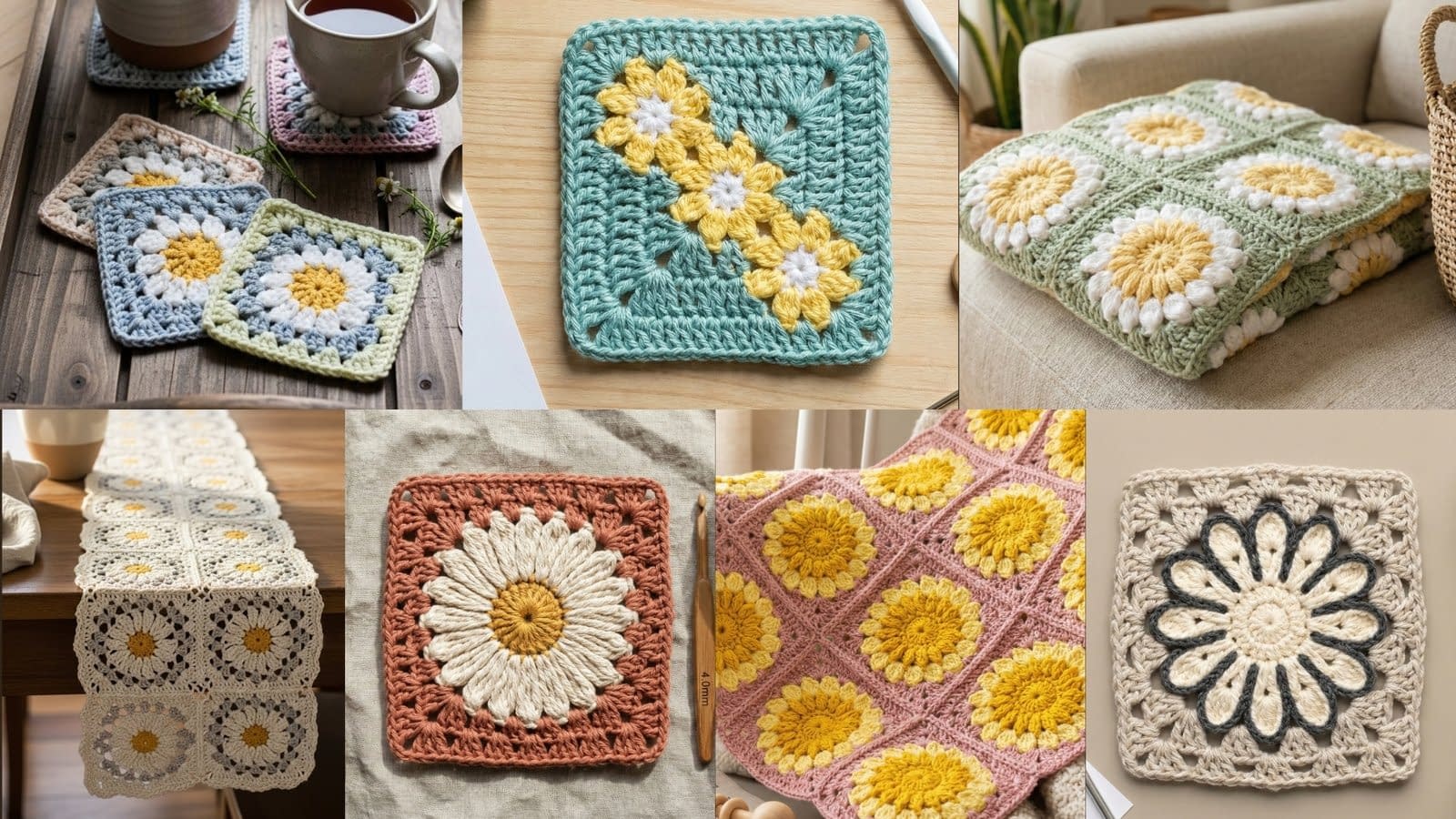
This guide is for crocheters who want exceptionally clear, detailed, and carefully written patterns that produce polished, photo-ready results. In this post, I will walk you through four complete patterns now, each written in long-form, step-by-step language that is suitable for beginners who read slowly as well as for intermediate makers who appreciate precision. The full collection will become the seven Crochet Daisy Granny Square Patterns once you tell me to continue. For now, you will receive a compelling introduction, a concise meta description, and four fully developed patterns: a Crochet Christmas Tree Gift Card Holder as an example project and three daisy-inspired granny squares that range from a classic single-daisy square to layered and mini-cluster designs.
Throughout these four patterns, you will find materials lists, exact stitch-by-stitch instructions using full stitch names (no shorthand), clear assembly directions, troubleshooting guidance, blocking and finishing notes, photography and styling tips for creating the high-quality flatlay images described earlier, and multiple variations so you can adapt the designs for blankets, cushions, bags, or standalone motifs. Read carefully and follow each instruction in order. If anything seems unclear, move forward anyway and adjust tension or yarn weight to suit your personal gauge.
How this post is organized
Each pattern section contains:
- Materials and tools
- Finished size and gauge guidance
- Step-by-step instructions
- Assembly and finishing
- Variations and advanced options
- Troubleshooting and tips for clean stitch definition and photographic presentation
Now, let us begin with the first pattern.
Single Daisy Granny Square — Classic Crochet Daisy Granny Square Pattern

Overview, finished size, and skill level
Skill level: Beginner to intermediate. This pattern is designed to teach the basic construction of a daisy set into a granny-square frame. It yields a finished square approximately twelve centimeters (roughly 4.7 inches) when worked in worsted-weight cotton yarn with a 4.0 millimeter hook.
Overview: The motif begins with a classic center ring, a first round that forms a daisy center and petals using clusters or elongated stitches, and subsequent rounds that create the granny-square border. The instructions are crafted to emphasize stitch definition so your finished square is crisp and suitable for blankets or projects that require uniform squares.
Materials
- Worsted-weight cotton yarn (weight category 4) in:
- White or cream for the daisy center.
- Pale yellow for the petals.
- Pastel mint for the granny-square border.
- Crochet hook: 4.0 millimeter (G) or as needed to achieve the specified finished size.
- Yarn needle for weaving ends.
- Scissors.
- Optional: blocking pins and a surface for wet blocking.
Gauge
Gauge is not critical for motif matching but for best results use the specified yarn and hook to approach the finished size. If you are working multiple squares into a blanket, ensure all squares are made with consistent tension and the same yarn and hook.
Stitch technique reminders
- Magic ring: Create a ring by making a small adjustable loop, working stitches into the loop, and pulling the tail to close the ring. An adjustable loop will make the center of the daisy tidy and small.
- Petal shaping: Use elongated stitches such as double crochet clusters or front post double crochet to create raised petal textures. The pattern below uses double crochet clusters that are worked into the center ring and anchored to form petal shapes.
- Granny-square corners: Use chain spaces and multiple double crochet clusters to form clear 90-degree corners.
Instructions — Round by round
Round one — daisy center:
- Form a magic ring with the chosen center color (soft white).
- Chain two. This chain two will count as the first half double crochet for the initial height if you use half double crochet, but in this pattern use chain two only to establish height for the first petal cluster if needed.
- Work six half double crochet into the ring if you prefer a low-profile center. Alternatively, for slight height variation, work six single crochet into the ring for a denser center.
- Pull the ring closed gently and join with a slip stitch into the first stitch. Do not fasten off if you prefer to continue directly into the petal rounds. If you fasten off, leave a tail to sew in later.
Round two — first petal layer:
- Join the petal color (pale yellow) in any stitch.
- Chain three to establish height for a double crochet petal.
- Work the following petal sequence six times around the center: in the same stitch work one double crochet, chain one, one double crochet. Slip stitch into the next stitch of the center to anchor the petal base.
- Repeat the petal sequence evenly around so that there are six petals. The chain one between double crochet pairs will provide separation and definition.
- After the sixth petal, join with a slip stitch to the base of the first petal or the chain three beginning, and fasten off if you prefer to change colors for the granny border.
Round three — forming a small stabilizing round:
- Join the petal color or a coordinating color in any petal base.
- Chain one. Work single crochet evenly around the motif, placing approximately two single crochet into each chain-one space and one single crochet in the middle of each double crochet petal if necessary. Adjust spacing so that the outer edge is approximately circular and will permit square shaping in the next rounds.
- Join with a slip stitch and fasten off or continue to the granny-square foundation.
Round four — beginning the granny-square frame:
- Join the border color (pastel mint) into any stitch along the stabilizing round.
- Chain three. Work two double crochet into the same space to form the first cluster for a granny-square corner.
- Chain two to form the corner space.
- Skip to the opposite side of the motif and work three double crochet into the same general area to form the opposite corner cluster, forming symmetry.
- Continue around the motif working three double crochet clusters separated by chain spaces and working corners as three double crochet, chain two, three double crochet.
- Aim to have four distinct corners after this round. Join with a slip stitch into the top of the beginning chain three and fasten off if you prefer a clean break.
Round five — building out the square and final border:
- Join the border color and chain three.
- Work two double crochet into the same space. Chain one and then work three double crochet into the next space if that space is not intended for a corner.
- When approaching a corner, work three double crochet, chain two, three double crochet into the chain-two corner space of the prior round.
- Continue working around until the square is complete and the outer edge is even and flat.
- To finish, work a neat round of single crochet around the outside edge: place single crochet evenly and in corner spaces work two single crochet so that edges remain crisp.
- Fasten off and weave all ends securely to the wrong side of the square.
Assembly and finishing
- Blocking: To achieve precise square edges block your pieces gently. Pin the square to a blocking surface measuring twelve centimeters and spray lightly with water, or steam-block carefully with an iron held at a distance. Allow to dry fully before unpinning.
- Weave in ends on the wrong side and trim close. Use a tapestry needle to bury tails between stitches rather than along the surface where they may show.
Variations and adaptations
- Alternate petal stitch: Use front post double crochet for each petal to create more sculptural petals with extra texture.
- Two-tone center: Work the daisy center in a contrasting color for visual pop.
- Multiple petals: Increase to eight petals by working more petal sequences into the center and adjust the stabilizing round to accommodate the extra petal spacing.
Troubleshooting and tips
- If petals are crowded, reduce the number of double crochet stitches per petal or increase the chain space between petals.
- If the square puckers, work fewer stitches in the stabilizing round or use a larger hook for the petal rounds so the fabric lays flatter.
- For photographs, use natural window light and a 50 millimeter lens at f/2.8 to emphasize fiber detail and create a soft background blur. Include props such as a wooden hook and small skeins to convey scale.
Layered-Petal Daisy Granny Square — Two-Layer Petal Effect

Overview, finished size, and skill level
Skill level: Intermediate. This pattern produces a daisy with an inner petal layer and an outer petal layer for sculptural depth. Finished size: Approximately twelve centimeters when worked in a soft cotton-bamboo blend and a 3.5 to 4.0 millimeter hook. Use a slightly smaller hook for a crisp look when using the slightly shiner cotton-bamboo yarn.
Overview: The motif works an inner petal layer in a bright sunflower yellow and an outer petal layer in lemon, creating visible dimension. The border in dusty rose frames the motif for a modern, editorial look. The pattern requires color changes and the ability to work cluster stitches and slip-stitch join techniques.
Materials
- Cotton-bamboo blend yarn, worsted to light-worsted weight:
- Sunflower yellow for inner petals.
- Lemon for outer petals.
- Dusty rose for border.
- Crochet hook: 3.5 to 4.0 millimeter metal hook.
- Yarn needle, scissors, stitch markers.
- Optional: row counter or sticky note to mark rounds.
Instructions — round by round with descriptive steps
Round one — inner center:
- Create a magic ring.
- Chain two to set height and then work four half double crochet into the ring to produce a small solid center. Adjust to six half double crochet if you prefer a fuller center.
- Pull the ring closed and join with a slip stitch. Leave the yarn attached to continue to the next round.
Round two — inner petal foundation:
- Using the sunflower yellow, join with a slip stitch to any top of a half double crochet of the center.
- Chain three, then work one double crochet in the same stitch, chain one, and slip stitch into the next stitch to anchor the petal base.
- Repeat this petal sequence for six petals around the center. After the final petal join with a slip stitch and fasten off the sunflower yarn if you will change colors for the outer petal layer.
Round three — outer petal layer build:
- Join the lemon color in the chain-one space between two of the inner petals.
- Chain three. Into the chain-one space work a sequence that will extend beyond the inner petal: one double crochet, one treble crochet, one double crochet. This elongated central treble will give height to the outer petal so it visually overlaps the inner petals.
- Slip stitch into the chain space on the opposite side of the inner petal to anchor the outer petal.
- Repeat around to create six outer petals that sit midway between the inner petals and have taller central stitches to create a layered look.
- Join with a slip stitch and fasten off the lemon yarn.
Round four — stabilizing round:
- Join dusty rose at any desired point and work single crochet stitches evenly to stabilizing the outer petal layer. Place two single crochet in the larger gaps that appear to create a more even circumference.
- When you reach a corner area, prepare to transform the circular motif into a square by working single crochet clusters separated by chain spaces.
Round five — forming corners and square shape:
- Continue with dusty rose and chain three, work two double crochet into the same space to begin the first corner.
- Chain two, then work three double crochet into the same corner space so that you form three double crochet, chain two, three double crochet for the corners.
- Between corners work three double crochet clusters into each side space as needed to achieve a balanced square.
- Work until the square edge is formed and the motif measures approximately twelve centimeters.
- Finish with a neat single crochet round for edge definition. Work two single crochet into corners to maintain square shape.
Assembly, blocking, and finishing
- Block the square lightly to even out petal edges. Pin the petals gently to preserve their three-dimensional structure and avoid flattening.
- Use a small amount of starch or fabric medium if you wish to keep the petals standing for decorative applications.
- Weave ends on the wrong side and trim.
Variations and creative uses
- Use a slightly heavier yarn for the border to frame the petals with greater contrast.
- Create a blanket by alternating layered-petal squares with single-daisy squares for texture contrast.
- Add a small bead in the center for a little sparkle when used as an appliqué.
Troubleshooting and photographic notes
- If the outer petals do not overhang the inner petals, work the central stitch of each outer petal taller (for example, work treble crochet or a cluster of double crochet).
- For the bright, high-key studio look described in your earlier flatlay, use bright diffuse daylight and minimal shadows. Shoot at f/4 for crisp focus across the layered petals while maintaining moderate background separation.
Mini-Cluster Daisy Granny Square — Three Tiny Daisy Cluster

Overview, finished size, and skill level
Skill level: Advanced-beginner to intermediate due to small-scale precision work. Finished size: Approximately 6 to 7 centimeters depending on tension; this is intended as a mini square suitable for earrings, appliques, or precision patchwork.
Overview: This pattern creates a mini square composed of three tiny daisies arranged diagonally. Use sport-weight cotton and a 3.0 millimeter hook to achieve crisp small stitches. The pattern includes instructions for making tiny daisy centers and petite petals and joining them into a compact square.
Materials
- Sport-weight cotton yarn (lighter than worsted).
- Bright white for centers.
- Sunny yellow for tiny petals.
- Soft teal for the border.
- Crochet hook: 3.0 millimeter.
- Precision tapestry needle.
- Small wooden button or scale object for reference if photographing.
- Embroidery scissors for trimming tiny tails.
Instructions — making the tiny daisies
Tiny daisy — center and petal assembly (make three, arranged diagonally):
- Chain four and join with a slip stitch to form a small ring. You may prefer the adjustable magic loop method for the tightest center.
- Chain one and work six single crochet into the ring to form a small, dense center. Pull the ring closed and join with a slip stitch to the first single crochet.
- Fasten off the center color or continue directly to the petal color.
Tiny petal round:
- Join the sunny yellow into any stitch adjacent to the center.
- Chain two. Work one double crochet into the same stitch. Chain one and slip stitch into the next stitch of the center to anchor the petal.
- Repeat for a total of six tiny petals around the center. Each petal consists of double crochet, chain one, slip stitch anchor.
- After completing six petals, fasten off leaving a small tail for joining.
Assemble three daisies:
- Make three identical mini daisies.
- Arrange them diagonally so they form a compact cluster with a slight overlapping or touching edge.
- To join, position the daisies and use the soft teal yarn to work small joining stitches through adjacent petals. Use a tapestry needle and whip stitch or single crochet join-on-the-spot technique: with the right side facing, insert the hook through the outermost stitch of one petal and then through the corresponding stitch of the adjacent petal and work a single crochet to bind them. Repeat to secure at three or four contact points to prevent gaps while preserving petal shape.
Form the mini-cluster square border:
- Once the daisies are joined, join the soft teal border yarn to any point on the cluster.
- Chain three and work a sequence of single crochet and small chains to create a rectangular edge. Because the interior is irregular, work single crochet around, placing two single crochet into gaps and working corners as two single crochet separated by chain two spaces to achieve a square outline.
- Aim for overall symmetry: when you reach the midpoint of each side, adjust the number of single crochet so that the final shape is approximately square.
Final edge and finishing:
- Finish with one round of single crochet for a neat edge. For small projects, close stitches tightly to avoid distortion.
- Weave in ends carefully. Because of the small scale, use the tapestry needle to bury tails deep into the neighboring stitches.
- Press lightly or steam-block by holding an iron a safe distance to maintain petal shape without flattening the texture.
Variations and advanced uses
- Add a tiny bead in the center of each mini daisy for a decorative accent.
- Make a set of mini-cluster squares and join them together for a delicate shawl border or decorative trim.
- Turn the mini squares into earrings by attaching a small metal ring or wire through the top corner and adding earring hooks.
Troubleshooting and photographic tips
- Use light reflectors when photographing to reduce harsh shadows and preserve the clarity of tiny stitches.
- For macro shots use a tripod and a 50 millimeter lens, f/3.5 or slightly smaller aperture, to maintain overall sharpness.
- If the tiny petals collapse when blocked, consider using a smaller hook for the petals or a slightly stiffer cotton yarn to preserve shape.
Sunburst Daisy Granny Square — Radiant Sunburst Center with Granny Border

Overview, finished size, and skill level
Skill level: Intermediate. This motif combines raised puff-style center stitches with radiating daisy petals and a traditional granny square frame. The pattern requires consistent tension for the radial structure and careful placement of puff stitches so the sunburst reads cleanly.
Finished size: Approximately thirteen centimeters (about 5.1 inches) when worked with worsted-weight cotton yarn and a 4.0 millimeter crochet hook. Finished size may vary slightly with individual tension; if making multiple squares for a blanket, make a gauge sample and adjust hook size to match.
Design intent: The Sunburst Daisy Granny Square is intended to create a warm, sculptural flower that reads radiantly from the center outward. The raised puff-stitch center forms a sun-like core, followed by radiating daisy-style petals in cream that are then framed by a muted terracotta granny-square border to anchor the motif. The finished square should display strong radial stitch structure, clean color transitions, and a tidy square edge.
Photography and styling note: For a photorealistic flatlay set as you described, present the finished square centered on neutral linen fabric with natural daylight from the upper-left to cast gentle shadows that emphasize puff height. Include wooden crochet hook, neatly wound yarn cakes in the three palette colors, and a ceramic yarn bowl as props. Photograph with a 50 millimeter lens at about f/4 for full-stitch clarity.
Materials
- Yarn:
- Warm golden-yellow worsted-weight cotton for the puff center.
- Soft cream worsted-weight cotton for the daisy petals.
- Muted terracotta worsted-weight cotton for the granny-square border.
- Crochet hook: 4.0 millimeter (G) or adjust for your tension.
- Yarn needle for weaving ends.
- Scissors.
- Blocking pins and a blocking surface for final shaping.
- Optional: stitch marker to mark round starts.
Stitch reminders and technique notes
- Puff stitch used here: yarn over, insert hook into designated stitch or center, yarn over and pull up a loop; repeat the yarn over and pull-up loop sequence the specified number of times so that multiple loops accumulate on the hook; yarn over and pull through all loops on the hook; chain one to close and anchor the puff if desired. Consistency in the number of yarn overs and pull-up loops is critical for even puff size.
- Working into the magic ring produces a tidy central cluster.
- When changing colors, carry a short tail and weave securely on the wrong side.
- Blocking will help petals and the square edge sit flat and evenly.
Instructions — Round by round (long-form, step-by-step)
Round one — sunburst puff center:
- Make an adjustable magic ring: form a loop with the working yarn, hold the tail and loop, and insert the hook into the loop to begin working stitches. This adjustable start will allow you to draw the center closed tidily at the end of the round.
- With warm golden-yellow yarn, chain one to secure the start.
- Work eight puff stitches into the magic ring. To form each puff stitch: yarn over, insert the hook into the ring, yarn over and pull up a loop; repeat yarn over and pull-up loop three more times so that there are nine loops on the hook (the exact number of pull-ups may be adjusted but must be consistent for each puff in the round); yarn over and draw the yarn through all nine loops on the hook; chain one to close the puff and anchor it. Work these puff stitches evenly spaced around the ring so that the puffs form a full circular sunburst center.
- After completing the eighth puff, gently pull the tail of the magic ring to close the center so it sits compactly but not so tight that the puffs bunch; the puffs should remain round and distinct.
- Slip stitch into the base of the first puff to join the round. Do not fasten off yet if you prefer to anchor the next round directly; leave yarn attached if you will proceed to the anchoring round.
Round two — anchor round (secure the puff cluster and create a foundation for petals):
- Chain one.
- Work one single crochet into the top of each puff stitch around. Because puff stitches are tall, aim to insert the hook into the space between the top loops of the puff so the single crochet sits close to the puff, forming a neat ring of single crochet anchors surrounding the puff center.
- After working one single crochet into the top of every puff, join with a slip stitch to the first single crochet and fasten off the golden-yellow if you will change color for the petals. Leave a tail for weaving in or carry color neatly to the next round.
Round three — petal foundation and initial petal height:
- Join the soft cream yarn with a slip stitch into any single crochet anchor from the previous round.
- Chain three. This chain three will form the beginning height for the first petal.
- Into the same anchor work one double crochet. Chain one. Slip stitch into the next single crochet anchor to secure the petal base.
- Repeat this petal sequence evenly around so that there are eight radiating petal bases corresponding to the eight puff stitches in the center. Each petal base will therefore be composed of chain three, one double crochet, chain one, and slip stitch into the next anchor. This technique spaces petals so they stand away from the center and read as radiating rays.
- After the final petal base is placed, join with a slip stitch to the base of the first petal foundation and do not fasten off if you will build a second petal row.
Round four — petal shaping and rounding:
- With the soft cream yarn still attached, chain two to set height for the shaping row.
- Working into the chain-one space of each petal foundation, work the following sequence to create a rounded petal shape: one half double crochet, two double crochet, one half double crochet. This builds an arched petal that is wider and rounded at the top.
- Between petals, slip stitch into the top of the next petal foundation to anchor the petal and maintain spacing.
- Repeat this petal shaping sequence around for each of the eight petals. After finishing the last petal, join with a slip stitch to the top of the first half double crochet of the round.
- Fasten off the cream yarn if you prefer a clean color break before stabilizing the outer edge.
Round five — stabilizing the petal outer edge:
- Join the cream color again or a coordinating neutral if needed and work one round of single crochet in the top loops of the petal shaping round. Place one single crochet in the middle of each petal top and one single crochet in the slip-stitch anchor spaces between petals so that the circumference becomes even and suitable for square shaping.
- Distribute stitches evenly; if the circumference is slightly small, work an occasional increase of two single crochet in one petal top to keep the round from puckering.
- Join with a slip stitch at the end of the round and leave yarn attached for the granny-frame foundation.
Round six — beginning the granny-square frame in terracotta:
- Join the muted terracotta color with a slip stitch into any single crochet on the stabilizing round.
- Chain three. Work two double crochet into the same space to form the first cluster that will serve as the start of the first corner.
- Chain two to form the corner chain space and then work three double crochet into the same corner space so that your first corner is three double crochet, chain two, three double crochet.
- Move along the side of the motif and locate a roughly even grouping of single crochet stitches between petals where a side cluster will sit. Work three double crochet clusters separated by a chain one as needed across the side so the motif will expand evenly into a square. The aim is to have four distinct corner openings that will become the square corners.
- When you reach what will become the next corner, work three double crochet, chain two, three double crochet and continue around.
- At the completion of this round you should have four corner spaces formed by chain-two gaps and side clusters of three double crochet. Join with a slip stitch to the top of the initial chain three and fasten off or continue to the next round if you require a larger square.
Round seven — building out sides for a neat square:
- Join terracotta again in any corner space with a slip stitch.
- Chain three to begin. Work two double crochet into the same corner space, chain one, then work three double crochet in the next side space; when you approach the corner chain-two of the previous round work three double crochet, chain two, three double crochet to form that corner.
- Continue around adding side clusters and placing chain-one spaces between sets of three double crochet when needed to maintain flatness.
- For a balanced square consider working the following side sequence for each side: three double crochet cluster, chain one, three double crochet cluster, chain one, then corner cluster. This pattern will produce an even number of clusters per side so the square grows symmetrically.
- Join with a slip stitch to the top of the beginning chain three and assess the size; if the square is approximately thirteen centimeters, proceed to finishing. If larger is desired, add another round of similar granny clusters.
Round eight — neat outer edging:
- For a clean editorial edge work one final round of single crochet in terracotta around the square. In each corner work two single crochet separated by chain two to preserve corner shape and prevent rounding.
- Work single crochet evenly along sides and adjust stitch count slightly to keep edges flat.
- Fasten off and weave ends securely to the wrong side using a yarn needle. Bury yarn tails through multiple stitches, especially the puff center tails, to ensure they will not pull loose.
Assembly, blocking, and finishing
- Blocking:
- Pin the square to a blocking surface measuring thirteen centimeters square.
- Gently stretch each side until edges are straight and pin into position. Use additional pins to shape the petals symmetrically and to support the puff center without flattening it.
- Lightly mist with water using a spray bottle and allow to dry completely. Do not press the puff center flat during blocking; maintain vertical height by pinning around the puff rather than on top of it.
- Weaving ends:
- Use a tapestry needle to bury all tails on the wrong side of the motif. For puff stitch tails weave them through several rounds worth of stitches to prevent them from working loose.
- Trim yarn tails close after weaving and tuck the ends.
- Final quality check:
- Inspect for balanced petal spacing and consistent puff sizes. If one puff is noticeably smaller, carefully loosen the puff by pulling a small amount of yarn through the original working loop and adjust the puff size by redistributing loops if necessary.
Variations and creative options
- Alternate center method:
- For a stronger vertical profile create the center using bobble stitches instead of puff stitches; the technique requires forming bobble groups and closing them with a final yarn over draw-through, producing a tightly clustered center.
- Petal variation:
- Substitute treble crochet for the double crochet elements in the petal shaping round to create taller petals and a more sculptural silhouette.
- Border variation:
- Add a decorative final round of reverse single crochet (crab stitch) in terracotta for a slightly raised editorial edge before the final single crochet round.
- Color-play:
- Use a deeper terracotta or a contrasting border color if you want the frame to ground the motif dramatically. Using a neutral border color will emphasize the sunburst center.
- Use-case ideas:
- Use Sunburst Daisy Granny Squares as focal motifs in a throw by placing them at regular intervals amid simpler solid squares.
- Make larger cushions by joining four Sunburst squares to create a central medallion.
Troubleshooting and tips
- Puff consistency:
- If puffs vary in size, ensure you use exactly the same number of yarn-over and pull-up sequences for each puff stitch and draw loops to a similar tension before completing the stitch.
- Petal crowding:
- If petals crowd or overlap irregularly, reduce the number of increases in the stabilizing round so fewer stitches are present around the petal base; alternatively, increase chain spaces between petals in the initial petal foundation round.
- Square distortion:
- If the square pulls in at sides, add an extra chain-one space between side clusters in the first granny round; if the square flares, remove some chain-one spaces or use a slightly smaller hook for the border rounds.
- Photography:
- For your described ultra-realistic flatlay use a neutral linen background, natural daylight from the upper-left, and a 50 millimeter lens at f/4 to achieve a sharp, even field where puff height and petal curves are clearly visible. Arrange props with careful negative space to keep the square centered and the eye focused on radial structure.
Vintage Lace Daisy Granny Square — Delicate Openwork Daisy Motif

Materials
- Fine cotton yarn, DK to light-worsted weight recommended for lace detail.
- Yarn colors:
- Soft butter yellow for the small daisy center.
- Ivory for the lace-style petals and openwork rounds.
- A coordinating neutral for the granny border if desired.
- Crochet hook: 3.5 millimeter for crisp lace stitch definition.
- Yarn needle for weaving ends.
- Blocking pins and a blocking surface for precise openwork shaping.
- Scissors and optional small stitch markers.
Finished size and skill level
Skill level: Advanced-beginner to intermediate. This pattern relies on attention to stitch spacing and consistent tension to keep openwork even.
Finished size: Approximately eleven to twelve centimeters when worked in the specified yarn and hook.
Overview and design intent
This Vintage Lace Daisy Granny Square is designed to read as delicate and airy. The pattern deliberately uses chain spaces to form lace petals and openwork borders so that light will pass through the motif. The final square is elegant, suitable for heirloom-style projects, decorative inserts, or a refined blanket when combined with denser squares.
Stitch technique reminders
- Chain spaces create lace and should be worked with consistent tension so that chains do not sag.
- When working double crochet clusters that form petals, anchor them securely into the same base stitch or ring so that petals are evenly spaced.
- Blocking is essential for lace motifs to open the stitchwork and reveal the pattern.
Instructions — round by round
Round one — small center:
- Make an adjustable magic ring or chain four and join with a slip stitch to form a ring if you prefer the fixed start.
- Chain one to secure the start and work six single crochet into the ring for a compact center. This creates a tidy small center around which the lace petals will form.
- Pull the ring closed if using the adjustable method and join with a slip stitch to the first single crochet.
Round two — forming delicate petal bases:
- Join the butter yellow in any stitch.
- Chain two. Work a sequence of three half double crochet into each of six evenly spaced stitches to create a slightly raised petal base. Alternatively, work two half double crochet and one single crochet for a lower profile.
- After completing the sequence around, join with a slip stitch to the top of the beginning chain and fasten off the yellow if changing to the ivory for the lace.
Round three — lace petal formation:
- Join ivory into the chain space between two petal bases.
- Chain four to create an elongated loop that will form the outer petal. Skip the next base and slip stitch into the subsequent chain base to anchor the loop. Repeat this chain-four loop six times around to generate open petal arcs over the petal bases.
- Join with a slip stitch and fasten off if you will stabilize the open petals in the next round.
Round four — stabilizing openwork:
- Join ivory and work single crochet around, placing single crochet into each double crochet base and one single crochet in the middle of each chain-four loop. This yields a series of small single crochet anchors that define the lace shape while preserving airiness.
- Join with a slip stitch and leave yarn attached for the initial border round.
Round five — forming the granny-square foundation:
- With the border color join in any stitch on the perimeter.
- Chain three and work two double crochet into the same space to form the beginning of the first corner cluster.
- Chain two for the corner space, then work three double crochet into the same corner space.
- Proceed around placing side clusters of three double crochet separated by chain-one spaces where necessary. When shaping sides between corners, work three double crochet into evenly distributed spaces. Adjust spacing by working more or fewer single crochet anchors in the previous round so that the square does not distort.
- Join with a slip stitch and fasten off or continue to additional rounds if you require a larger square.
Round six — neat outer edging:
- Join the border color and work one round of single crochet around the entire square for a tidy edge. In each corner work two single crochet separated by chain two to preserve corner crispness.
- Fasten off and weave all ends to the wrong side.
Blocking and finishing
- Pin the square to the blocking surface, carefully stretching lace loops into a pleasing, symmetrical shape. Use blocking pins to hold chain loops open without flattening the petals.
- Lightly mist with water and allow to dry completely before unpinning.
- If you desire long-term crispness for decorative items, consider a diluted fabric stiffener applied sparingly to the reverse side, tested on a scrap first.
Variations and uses
- Make the centre slightly larger by substituting half double crochet with double crochet in the first round for a more prominent center.
- Create a two-tone lace border by changing colors every round to emphasize the openwork.
- Use this motif as an insert for table runners, doilies, or lace trims on garments.
Troubleshooting and photographic notes
- If chain loop shapes are inconsistent, practice the chain tension on a swatch and relax your hands before working the motif.
- For photography, place the lace square on a darker neutral background to reveal the openwork. Use diffused daylight and a 50 millimeter lens at f/4.5 to capture both lace detail and texture.
Raised Puff Daisy Granny Square — Sculptural Puff-Center Motif

Materials
- Worsted-weight yarn in:
- Warm butter yellow for the raised puff center.
- White for surrounding petals.
- Sage green for the granny border.
- Crochet hook: 4.5 millimeter to accommodate plush puff stitches.
- Yarn needle, scissors, and a tapestry needle for weaving puff stitch tails safely.
- Optional: a stitch marker to mark the beginning of rounds.
Finished size and skill level
Skill level: Intermediate. The puff stitch requires consistent wrapping and controlled tension to form clean, even puffs.
Finished size: Approximately thirteen centimeters when using the specified yarn and a 4.5 millimeter hook.
Stitch technique reminders
- Puff stitch method: Yarn over multiple times, insert the hook into the stitch, yarn over and pull up loops multiple times, yarn over and draw through all loops on the hook to close the puff, then secure with a chain one or single crochet between puffs if desired for spacing.
- For raised texture work the puff stitch from the right side only to maintain a consistent front appearance.
Instructions — building the raised puff center and petals
Round one — forming the puff center:
- Make a magic ring or chain four and join into a ring.
- Chain one and work eight puff stitches into the ring. To form a puff stitch: yarn over, insert the hook into the ring, yarn over and pull up a loop; repeat the yarn over and pull up loop sequence four times so that you have nine loops on the hook; yarn over and pull through all loops; chain one to close and anchor the puff. Work eight of these puff stitches evenly around the ring.
- Join with a slip stitch to the top of the first puff stitch and leave yarn attached.
Round two — anchoring round:
- Chain one and work one single crochet into the top of each puff stitch to create a stable perimeter.
- Join with a slip stitch and change to the petal color.
Round three — forming rounded petals:
- Join white yarn into any single crochet.
- Chain three to set up height and work a sequence that forms rounded petals: in the same single crochet work one double crochet, chain one, one double crochet. Slip stitch into the next single crochet to anchor.
- Repeat to make eight rounded petals arranged around the puff center. Join with a slip stitch.
Round four — additional petal shaping:
- To create more rounded, pronounced petals, work a second row to each petal by chaining two and working two half double crochet into the chain-one space of the petal below, slip stitch to the next anchor.
- This reinforces petal shape and provides a pleasing contrast to the raised center.
Round five — stabilizing for the granny border:
- Join sage green and work single crochet evenly around, placing more single crochet in gaps created by the petal shapes so the outer edge becomes balanced for square shaping.
- Join with a slip stitch.
Round six — forming square corners and side clusters:
- Chain three and work two double crochet into the same space to begin corners.
- Chain two and then work three double crochet into the same corner space.
- Continue around working three double crochet clusters for sides and corners as required to fashion a square.
- For the outermost round work a tidy round of single crochet and in each corner work two single crochet separated by chain two.
Assembly and finishing
- Fasten off and weave ends through the wrong side. Because the puff stitch contains multiple loops and strands, use a tapestry needle to thread tails through several stitches to secure them so they do not unravel with use.
- Lightly block the square if necessary, pinning petals but taking care not to flatten the raised puff center.
Variations and creative uses
- For a more dramatic effect, use a thicker yarn for the puff center than for the petals, creating a strong tactile contrast.
- Combine raised puff squares with flatter squares in a blanket to create a tactile, sensory throw.
- Make a set of raised puff squares and join them with a reverse single crochet ridge for a decorative edge.
Troubleshooting and photographing puffy texture
- If your puff stitches are inconsistent in height, practice forming the puff on a scrap using the same number of yarn over sequences and maintain even tension when pulling loops through.
- For photography emphasize side lighting to cast gentle shadows that reveal vertical stitch depth. Use f/4 for edge-to-edge clarity and include a ceramic mug or bamboo hook in the frame to emphasize cozy scale.
Two-Tone Outline Daisy Granny Square — Crisp Contemporary Motif

Materials
- Smooth cotton yarn, DK to light-worsted weight.
- Colors:
- Cream for the daisy center and petal fill.
- Charcoal gray or deep tone for the petal outlines.
- Oatmeal for the granny border.
- Crochet hook: 3.5 to 4.0 millimeter depending on yarn.
- Yarn needle and scissors.
- Optional: printed stitch diagram for visual reference.
Finished size and skill level
Skill level: Intermediate. This pattern requires color changes and precise placement of outline stitches to achieve crisp contrast.
Finished size: Approximately twelve centimeters, depending on tension and yarn.
Design intent and technique explanation
This motif uses two tones to outline and emphasize petal shapes. The outlining is achieved by working a slim slip-stitch or single crochet outline along petal edges in contrast color. The effect reads editorial and modern — excellent for projects that benefit from graphic contrast.
Instructions — round by round with emphasis on outline technique
Round one — center:
- Create a magic ring.
- Chain one and work six single crochet into the ring. Join with a slip stitch and fasten off if you prefer to pick up petal color separately.
Round two — petal formation:
- Join the cream color and chain three. Work one double crochet, chain one, one double crochet into the same stitch to create a petal base around the center. Slip stitch to the next stitch to anchor.
- Repeat for six petals to create an even circular petal arrangement. Join with a slip stitch.
Round three — outline the petals:
- Join the charcoal gray in any stitch and work single crochet around the outer edge of each petal, inserting the hook into the spaces between the double crochet petals and working a single crochet that follows the petal curve. If you prefer a cleaner drawn outline, work slip stitch along the petal edge instead; single crochet will produce a slightly raised outline, while slip stitch will lie flatter.
- Work gently to maintain consistent tension so the outline sits close to the cream petals without pulling them in.
Round four — stabilizing round:
- With cream, work single crochet around to even out the outline and prepare for the square shaping. Place two single crochet in gaps as necessary to maintain shape.
- Join with a slip stitch.
Round five — forming the granny-square border:
- Join oatmeal color and begin transforming the circular motif into a square by working three double crochet clusters into the corner areas, chain two between clusters to form corners.
- Work three double crochet clusters for sides, placing chain one between clusters where required to preserve edge flatness. Adjust the number of clusters per side so that the square measures approximately twelve centimeters.
- Finish with a round of single crochet to create a crisp edge. In corner spaces work two single crochet separated by chain two.
Assembly, blocking, and finishing
- Block gently to square the motif and set the outline into place.
- Weave ends invisibly on the wrong side and trim.
Variations and styling
- Reverse the color palette for a lighter outline on a dark petal for a bold graphic look.
- Use an even finer yarn for the outline to make the outline appear hand-drawn and delicate.
- Combine two-tone outline squares in a grid for striking blankets, cushions, or wall hangings.
Troubleshooting and photography
- If outlines pull the petal edges, loosen tension when working the contrast color and consider using a hook half a size larger for the outline round.
- For editorial photography, use a matte neutral background and shoot at f/4.5 to produce sharp stitch edges. Keep lighting even to highlight the graphic contrast between outline and fill.
Final assembly options, joining methods, and project ideas
Joining techniques for mixed-texture blankets
When joining these varied daisy granny squares into a blanket or larger project, choose a joining method that complements both texture and desired visual seam.
Single crochet join:
- Place two squares with right sides facing each other.
- Insert the hook through the edge stitches and work single crochet through both layers to create a raised ridge on the right side. This join is sturdy and provides a decorative ridge.
Slip stitch seam:
- Place squares with right sides together and work slip stitch through both layers to create a low-profile seam.
- This method is less bulky and ideal when joining many textured squares.
Whip stitch mattress-seam:
- Use a tapestry needle and matching yarn to whip stitch into edge loops on the wrong sides to create an invisible join.
- This method produces a seamless look on the right side and is especially suitable for delicate lace motifs.
Continuous join-as-you-go method:
- Work one square completely and then join subsequent squares in place by crocheting into the adjacent square’s edge stitches as you form the final border round.
- This yields a clean, integrated look without long seams to sew.
Layout and design considerations
- Alternate dense and airy motifs to produce visual and tactile contrast.
- Use a neutral joining color to harmonize the collection or select a contrasting color to emphasize the grid structure.
- For blankets, plan layout on the floor before joining and photograph in natural light to check overall color balance.
Care, blocking, and long-term maintenance
- Wash handmade items according to the yarn manufacturer’s instructions. For cotton and cotton blends, hand wash in cool water with mild detergent and lay flat to dry.
- Re-block after washing if the project contains lace motifs to restore openwork shape.
- Store finished projects folded with acid-free tissue paper in a cool, dry place to avoid yellowing for light colors.
Pattern gallery checklist and one-page quick reference
Below is a concise checklist you can print or copy for quick reference while working. Use it as a pattern gallery summary.
- Pattern 1: Crochet Christmas Tree Gift Card Holder
- Hook: 4.0 millimeter
- Yarn: worsted weight
- Finished size: 3.5 inches by 5.5 inches
- Key techniques: triangular short-row increases, flap finishing, optional star and ornaments
- Pattern 2: Single Daisy Granny Square
- Hook: 4.0 millimeter
- Yarn: worsted cotton
- Finished size: approximately 12 centimeters
- Key techniques: magic ring, double crochet petal clusters, granny corners
- Pattern 3: Layered-Petal Daisy Granny Square
- Hook: 3.5–4.0 millimeter
- Yarn: cotton-bamboo blend
- Finished size: approximately 12 centimeters
- Key techniques: two petal layers, treble stitch height, color changes
- Pattern 4: Mini-Cluster Daisy Granny Square
- Hook: 3.0 millimeter
- Yarn: sport-weight cotton
- Finished size: approximately 6–7 centimeters
- Key techniques: tiny centers and petals, precision joining
- Pattern 5: Vintage Lace Daisy Granny Square
- Hook: 3.5 millimeter
- Yarn: fine cotton DK
- Finished size: 11–12 centimeters
- Key techniques: chain-space lace petals, openwork stabilization, blocking
- Pattern 6: Raised Puff Daisy Granny Square
- Hook: 4.5 millimeter
- Yarn: worsted
- Finished size: approximately 13 centimeters
- Key techniques: puff stitch, vertical texture, secure weaving
- Pattern 7: Two-Tone Outline Daisy Granny Square
- Hook: 3.5–4.0 millimeter
- Yarn: smooth cotton
- Finished size: approximately 12 centimeters
- Key techniques: contrasting outline, single crochet or slip-stitch outlining, graphic contrast
One-page quick reference actions:
- Check tension and make a test square of each motif.
- Block all squares to match dimensions before joining.
- Choose joining method based on bulk and desired seam visibility.
- Weave in ends as you go to reduce finishing time.
- Photograph motifs using natural light, 50 millimeter lens, and the aperture suggestions given for each style.
Concluding
Congratulations. You now have seven fully detailed and carefully written Crochet Daisy Granny Square Patterns, each developed with step-by-step instructions, material lists, finishing notes, photographic guidance, troubleshooting tips, and creative variations. These motifs span a wide range of skills and aesthetic outcomes: from the practical holiday Crochet Christmas Tree Gift Card Holder to the delicate Vintage Lace Daisy, the sculptural Raised Puff Daisy, and the modern Two-Tone Outline Daisy. Use the pattern gallery checklist to plan projects, test gauge, and block motifs to consistent size before joining.
If you will be turning these motifs into a single cohesive project such as a blanket, cushion, or garment, I recommend making a planning swatch of four squares joined with your chosen joining method and trimming the visual weight with narrow borders. That quick test will reveal whether you prefer a neutral joining color or a contrasting grid.