In the world of gift-giving and correspondence, the envelope is far more than just a protective wrapper; it is the first impression, the opening act, and a tactile promise of the sentiment inside. While digital messages vanish with a swipe, a handcrafted envelope carries weight, texture, and the undeniable warmth of human effort. Whether you are preparing invitations for a wedding, sending a heartfelt letter, or packaging a gift card, customizing your stationery elevates the experience entirely.
This comprehensive guide focuses on 7 Artistic Paper Envelope Tutorials derived from specific, high-end designs. We will move beyond the basic folded square and explore complex layering, texture integration, and structural paper engineering. We will cover the specific tools you need, the precise methods for scoring and folding, and the step-by-step assembly for each of the seven unique styles featured in our reference collection.
Essential Tools and Materials
Before diving into the specific tutorials, it is vital to assemble a toolkit that ensures professional results. The difference between a messy craft project and high-end stationery often lies in the precision of the tools used.
High-Quality Cardstock For these tutorials, standard printer paper is too flimsy. You will need cardstock ranging from 65lb to 80lb weight. This thickness provides the structural integrity needed to support embellishments like beads, lace, and 3D flowers.
Scoring Board and Bone Folder To achieve the crisp, sharp edges seen in these images, you cannot rely on hand folding alone. A scoring board allows you to create a recessed line in the paper fibers, while a bone folder helps you press the fold down flat without transferring oils from your fingers or cracking the paper surface.
Adhesives Different tasks require different glues. You will need:
- Double-sided tape or a tape runner: For adhering flat layers of paper together without warping.
- Precision liquid glue: For intricate die-cuts and lace.
- Hot glue gun: Strictly for attaching heavy 3D elements like paper roses, pearls, or satin bows.
Cutting Tools A guillotine paper trimmer is best for straight lines, while detail scissors are necessary for trimming lace and ribbon.
Tutorial 1: The Luxe Floral & Ribbon Envelope

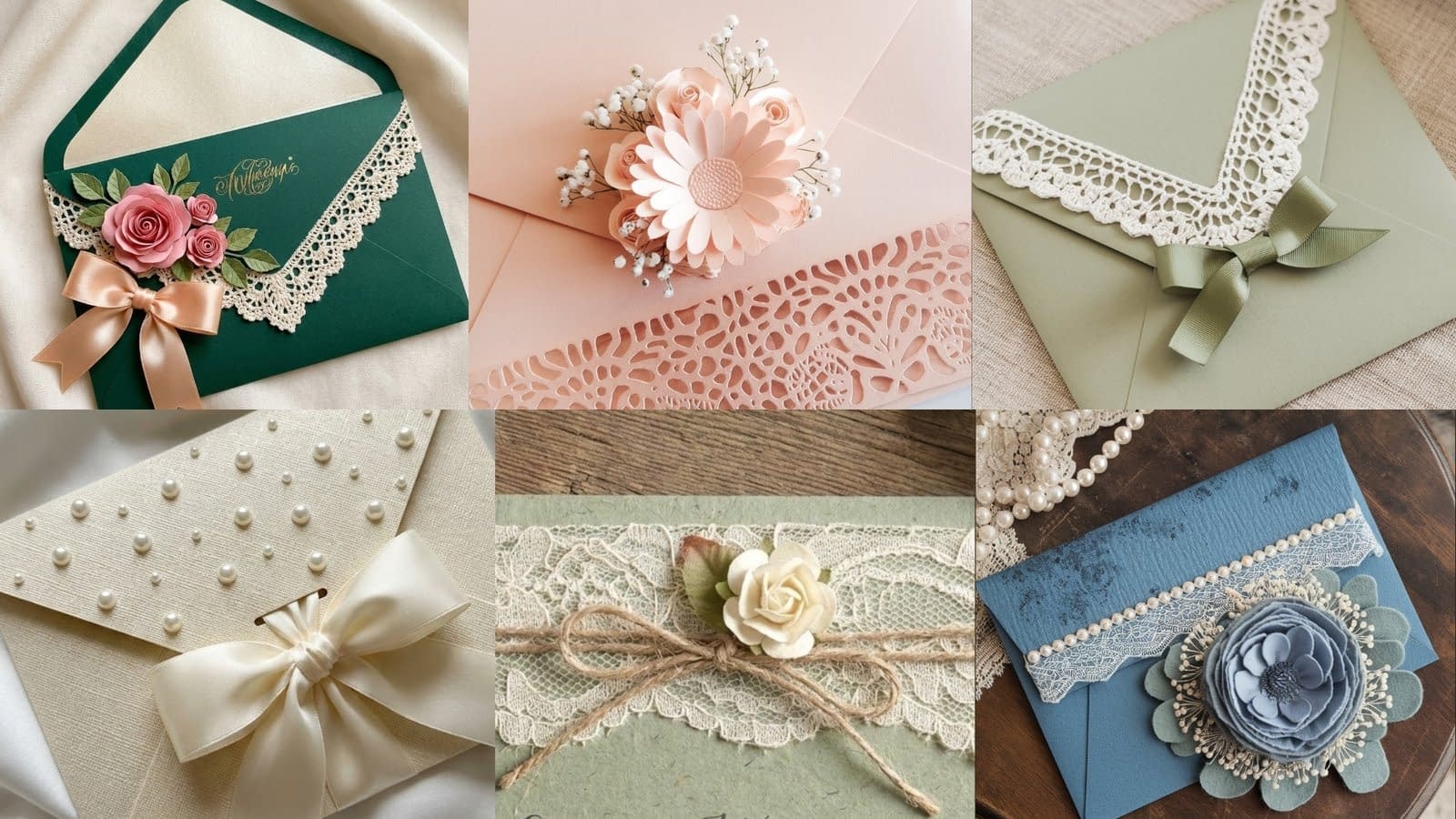
The first design in our 7 Artistic Paper Envelope Tutorials series is a study in elegance, featuring a deep emerald green base contrasted with cream accents, intricate lace, and three-dimensional paper roses. This style is ideal for luxury wedding invitations or formal announcements.
Preparing the Base Structure
Begin with a piece of deep green matte cardstock. To create a standard invitation size (A7), cut your paper to 10 inches by 7 inches. Place the paper horizontally on your scoring board. Score at 2.5 inches and 7.5 inches. This will create a center panel of 5 inches, a bottom flap of 2.5 inches, and a top flap of 2.5 inches.
Rotate the paper. On the top flap (which will be the closing flap), you need to create a pointed or “V” shape. Measure to the center point of the top edge. Use a ruler to draw a faint pencil line from that center point down to the left and right score lines. Cut along these lines to create a triangular flap.
Creating the Inner Liner
The image shows a cream-colored liner that peeks out when the envelope is open. Cut a piece of cream shimmer paper slightly smaller than your open envelope shape. It should be roughly 1/8th of an inch smaller on all sides. Slide this liner inside the green base. use double-sided tape on the back of the cream paper, focusing on the top triangular flap and the center panel. Do not glue the bottom of the liner all the way down, as this allows the paper to move slightly when folded, preventing buckling.
The Lace Application
Before closing the envelope side flaps (if you are making a pocket) or the bottom flap, you must apply the lace. Cut a length of wide, cream-colored crochet lace. Apply a line of strong liquid fabric glue along the bottom edge of the top flap’s exterior—or, as seen in the alternative variation, along the bottom pocket edge. Press the lace firmly into the glue. Ensure the ends of the lace are trimmed neatly or wrapped around to the back for a clean finish.
Floral Arrangement and Closure
Fold the bottom flap up and glue the side edges to create the pocket. Now, focus on the embellishment. Using a hot glue gun, attach a cluster of three paper roses—two smaller pink ones and one larger pink one—to the left side of the envelope flap or the corner of the pocket. Tuck artificial green leaves under the flowers before the glue sets. Finally, tie a bow using wide peach or champagne satin ribbon. Glue the knot of the bow directly beneath the floral cluster. This serves as a focal point and balances the visual weight of the flowers.
Tutorial 2: The Vintage Blue Lace Clutch

This design mimics the look of a vintage clutch purse. It features a heavy texture, blue floral motifs, and an abundance of pearls. It is perfect for winter themes or vintage-inspired events.
The Texture Technique
If you cannot find cardstock with a distressed, vintage blue pattern, you can create it. Take a piece of light blue cardstock and use a distressing ink pad in a darker blue or grey. Rub the ink pad along the edges and lightly across the center to create an aged look.
Constructing the Clutch Shape
Cut your paper to 8.5 inches by 11 inches. Score it in half to create a folder, or use an existing envelope template. The key feature here is the flap. Instead of a standard point, the flap here is covered entirely in texture.
Layering Lace and Pearls
This tutorial relies heavily on layering. Cut a piece of white scalloped lace that is exactly the length of your flap’s edge. Glue this on the underside of the flap so the scallops peek out. Next, take a string of adhesive pearls or individual flat-backed pearls. Using precision tweezers and a tiny dot of glue, place pearls along the upper border of the lace. This creates a jeweled hem effect.
The Floral Cluster
In the bottom right corner of the flap, create a dense arrangement. You will need fabric flowers rather than paper ones to match the soft texture of the image. Choose a large dusty blue fabric flower as the center. Surround it with smaller white stamens or filler flowers. Cut leaf shapes out of felt or thick textured paper in a muted green and glue them as the base layer. Adhere the entire cluster to the corner of the flap. This adds weight, so ensure your magnetic closure or velcro dot underneath the flap is strong enough to hold the envelope closed.
Tutorial 3: The Gentleman’s Tuxedo Card Holder

Among our 7 Artistic Paper Envelope Tutorials, this is the most structural and whimsical. It transforms a flat piece of paper into a tuxedo jacket, complete with lapels and a bowtie. It is perfect for groomsmen proposals or masculine birthday cards.
The Jacket Fold
Start with a rectangular piece of dark green cardstock, approximately 8 inches wide by 10 inches tall. You will be folding this to meet in the middle, like a gatefold card, but with a twist. Score vertical lines at 2 inches from the left edge and 2 inches from the right edge. This leaves a 4-inch panel in the center. Fold the side panels inward. These are the sides of your “jacket.”
To create the lapels, look at the top of your folded panels. Take the top inner corner of the left panel and fold it diagonally outward and down, creating a triangular flap that resembles a suit lapel. Repeat this on the right side. Try to make the angles identical so the jacket looks symmetrical. Press these folds down hard with your bone folder.
The Shirt Insert
Cut a piece of white cardstock that fits snugly inside the green jacket (slightly less than 4 inches wide). This represents the dress shirt. On the upper portion of this white cardstock, adhere a small black paper or satin bowtie. When you slide the white card into the green jacket, the bowtie should sit perfectly in the “V” created by the lapels.
Tailoring Details
To finish the look, you need buttons and a pocket. For the buttons, use small black brads or simply punch small circles out of black cardstock and glue them in a vertical line on the left side of the jacket, below the lapel. For the pocket, cut a small rectangle of the same green cardstock. Glue it to the right side of the jacket, applying glue only to the side and bottom edges to create a small opening. Cut a small triangle of grey or silver paper and tuck it into this pocket to represent a handkerchief.
Tutorial 4: The Rustic Romance Kraft Envelope

This design utilizes Kraft paper (brown recycled paper) to create a warm, rustic aesthetic. It features a belly band mechanism rather than a sealed flap, making it reusable.
working with Kraft Paper
Kraft paper has a distinct texture and often a fiber direction. When cutting your envelope shape (a standard rectangular A7 size works best here), cut with the grain to prevent cracking when you fold. Create a simple rectangular envelope where the flaps meet in the center.
The Lace Belly Band
Instead of gluing the envelope shut, we will make a removable band. Cut a strip of wide cream lace, long enough to wrap around the envelope with a 1-inch overlap. Wrap it around the closed envelope and use a small dot of hot glue to secure the lace to itself at the back. Do not glue it to the envelope paper.
The Jute Twine Wrap
Take a length of natural jute twine. Hold one end against the center of the lace band on the front of the envelope. Wrap the twine around the envelope three or four times. The multiple strands add visual interest. Tie the ends in a knot at the front center.
The Solitary Rose
To complete the rustic look, take a single small paper tea rose in a peach or yellow tone. Trim the wire stem off the back. Hot glue the flower directly onto the knot of the jute twine. This anchors the twine and provides a singular pop of color against the neutral brown and cream background.
Tutorial 5: The Delicate Die-Cut Floral Horizontal

This tutorial in our 7 Artistic Paper Envelope Tutorials list requires a bit more equipment, specifically an edge punch or a die-cutting machine. The design is a horizontal landscape envelope with an intricately cut bottom edge.
The Die-Cut Edge
Start with a sheet of pale blush or cream cardstock. Cut a strip that is 11 inches long and 5 inches wide. Before doing any folding, use an intricate “border punch” or a metal die along one of the long edges. This will create the lace-like paper pattern seen at the bottom of the design.
Scoring the Fold
Once the edge is punched, measure 3 inches up from the un-punched long edge and score a horizontal line. Fold this section down. This creates the top flap. The punched edge will act as the bottom decorative layer. You will likely need to attach a separate back panel to create the actual pocket, as the punched edge is too delicate to serve as structural support. Cut a rectangle of the same paper and glue it to the back of the top section, creating a pocket behind the lace front.
The Central Cluster
The embellishment here is centered horizontally. Cut a narrow strip of paper or lace and run it horizontally across the flap, about an inch above the bottom edge. In the exact center of this strip, adhere a cluster of flowers. Use one large white daisy or flat paper flower as the base, and layer smaller peach roses on top. Add small sprigs of white filler flowers (like baby’s breath) to extend the cluster horizontally.
Tutorial 6: The Pearl-Studded Bridal Pocket

The final design is a masterpiece of texture, utilizing linen-finish paper and a grid of pearls. This is a “pocket fold” style envelope often used for holding multiple wedding enclosure cards.
Selecting Textured Paper
The image shows a paper with a visible crosshatch or linen texture. This texture is crucial because a smooth paper would look too plain behind the pearls. Cut your paper to create a V-flap envelope.
The Pearl Grid
This step requires precision. You want the pearls to look like a deliberate pattern, not a random scattering. Use a ruler and a pencil to lightly mark a grid of dots on the V-flap. Space them approximately 1 inch apart. Place a small self-adhesive half-pearl on each dot. Press firmly. If you are worried about them falling off during mail transit, add a tiny dot of superglue to each pearl before placing it.
The Satin Bow Closure
The closure for this envelope is a large, luxurious satin bow. Cut a slit in the tip of the V-flap and a corresponding slit in the bottom panel of the envelope. Thread a wide cream satin ribbon through these slits. When the envelope is filled, tie the ribbon in a large bow on the outside. This serves as the closure mechanism, holding the flap down without the need for adhesive on the paper itself.
Conclusion
Mastering these 7 Artistic Paper Envelope Tutorials gives you a versatile repertoire of skills, from structural folding to delicate embellishment. Whether you are drawn to the masculine lines of the tuxedo fold or the vintage charm of the lace clutch, the key to success lies in patience and precision.
Remember that paper crafting is an iterative process. Your first attempt might have a slightly crooked fold or a glue smudge, and that is perfectly fine. As you practice handling the cardstock and manipulating the materials, your hands will learn the right amount of pressure to apply for a crisp crease and the perfect amount of glue for a clean bond.
We encourage you to experiment with these designs. Try the tuxedo fold in navy blue, or the lace clutch in a deep burgundy. The techniques outlined in these 7 Artistic Paper Envelope Tutorials are merely the starting point for your own creative expression. Gather your materials, clear your workspace, and start creating stationery that will be treasured just as much as the message inside.